
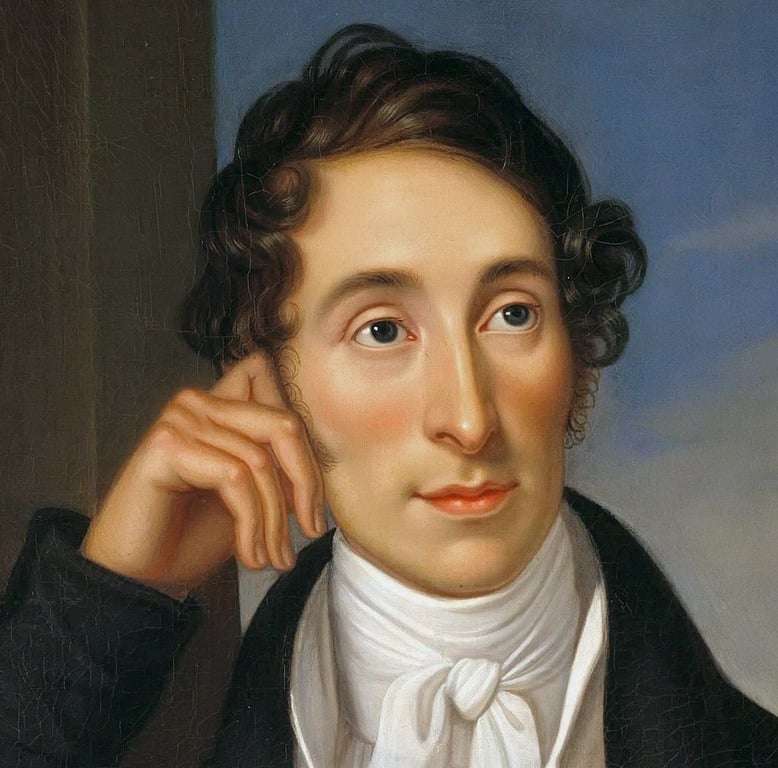
Carl Maria von Weber was a German composer, conductor, pianist, and music critic who was one of the leading figures in the Romantic movement.
Weber was born on November 18, 1786, in Eutin, a small town in northern Germany. His father, Franz Anton von Weber, was a musician and theater director, and his mother, Genovefa Brenner, was a singer.
Weber showed a talent for music from a young age, and he began studying piano with his father at the age of four. He also received instruction in violin, cello, and composition.
In 1804, Weber began studying at the University of Heidelberg, where he pursued a general education as well as music studies. He left the university without completing a degree and moved to Salzburg, where he worked as a private music tutor.
Weber's first major success as a composer came in 1810, when his opera "Abu Hassan" premiered in Munich. He went on to write several other operas, including "Der Freischütz", which is considered one of the most important German operas of the Romantic era.
In addition to his work as a composer, Weber was also an accomplished conductor and pianist. He served as music director at several German theaters, including the Dresden Opera, and he was known for his innovative approaches to conducting and his virtuosic piano performances.
Weber's critical writing on music was also influential in his time. He wrote numerous essays and reviews on music, and he was a leading advocate for the development of a distinctively German style of music.
Weber's life was cut short by illness, and he died in London on June 5, 1826.