
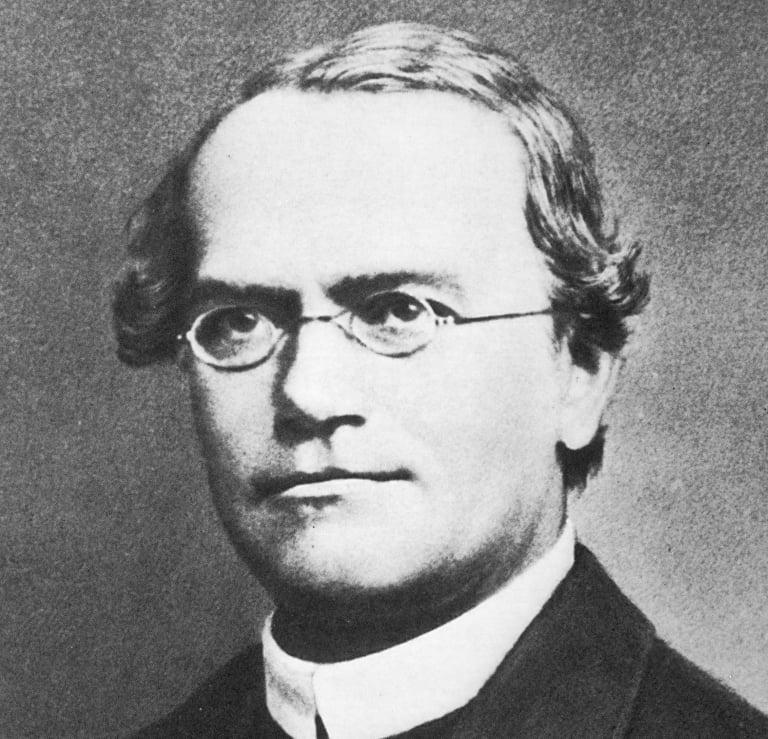
Gregor Mendel was a scientist and Augustinian friar who is considered the father of modern genetics. He was born on July 20, 1822, in Heinzendorf, Austria, to a family of farmers.
Mendel studied at the University of Vienna, where he was influenced by the botanist Franz Unger. In 1843, he entered the Augustinian Abbey of St. Thomas in Brno, Czech Republic. There, he began his experiments on plant hybridization, which would later become the foundation of modern genetics.
Mendel conducted his experiments on pea plants, carefully crossbreeding different varieties and observing the traits of the offspring. He discovered that certain traits, such as flower color and seed texture, were passed down from parent to offspring in predictable patterns. He also found that some traits were dominant over others, meaning they would always be expressed in the offspring when present in a parent.
Mendel published his findings in 1865 in a paper titled "Experiments on Plant Hybridization," which he presented to the Natural History Society of Brno. However, his work was largely ignored by the scientific community at the time.
It wasn't until the turn of the 20th century, after the rediscovery of Mendel's work by scientists such as Hugo de Vries, Carl Correns, and Erich von Tschermak, that his work began to be recognized as a seminal contribution to the understanding of genetics. His work laid the foundation for the laws of inheritance and the study of genetics, which continue to shape the field of biology today.
Mendel died on January 6, 1884, in Brno. His legacy lives on as one of the most important discoveries in the history of science.