
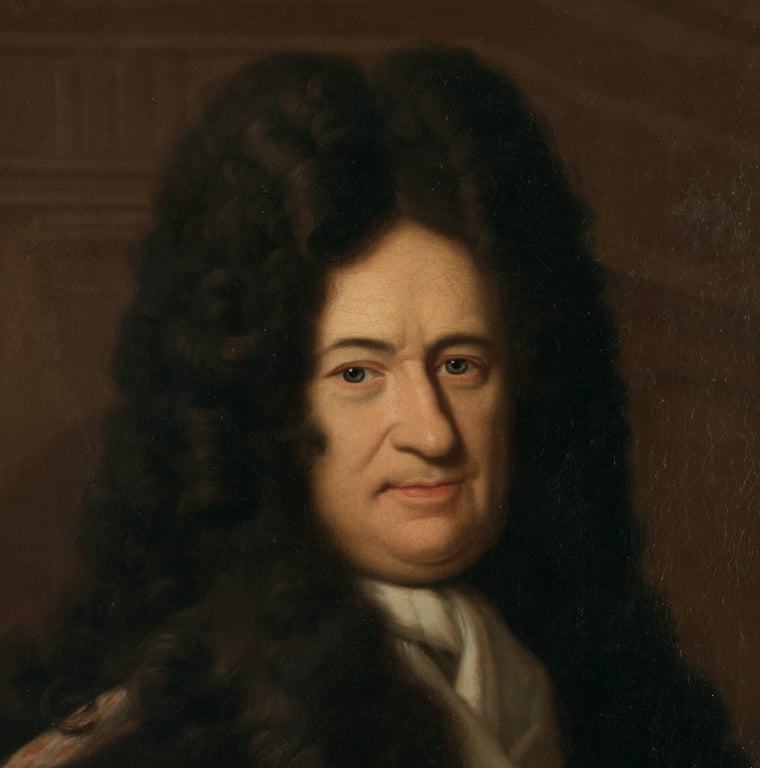
Gottfried Wilhelm Leibniz was a German philosopher, mathematician, and scientist who made important contributions to many fields of knowledge during his lifetime. Leibniz was born on July 1, 1646, in Leipzig, Germany, to a prominent family of scholars and lawyers. His father, Friedrich Leibniz, was a professor of moral philosophy at the University of Leipzig, and his mother, Catharina Schmuck, was the daughter of a prominent jurist.
Leibniz was a precocious child who began to study Latin and Greek at an early age. He entered the University of Leipzig at the age of 15 to study law but soon developed an interest in mathematics and philosophy. Leibniz was deeply influenced by the works of René Descartes and Baruch Spinoza, and he began to develop his own system of philosophy, which he called "monadology."
Leibniz is best known for his development of the calculus, which he worked on independently of Sir Isaac Newton. He also made important contributions to the fields of physics, logic, and metaphysics. Leibniz was a polymath who worked on a wide range of topics, including theology, history, and linguistics.
Leibniz was a prolific writer who corresponded with many of the leading intellectuals of his day. He wrote more than 15,000 letters during his lifetime, many of which have survived and provide insights into his thinking and intellectual development. Leibniz's most famous work is probably the "Monadology," which was published posthumously in 1720.
Leibniz died in Hanover, Germany, on November 14, 1716, at the age of 70. He was a highly influential thinker whose ideas strongly influenced the development of many fields of knowledge, including mathematics, physics, and philosophy.