
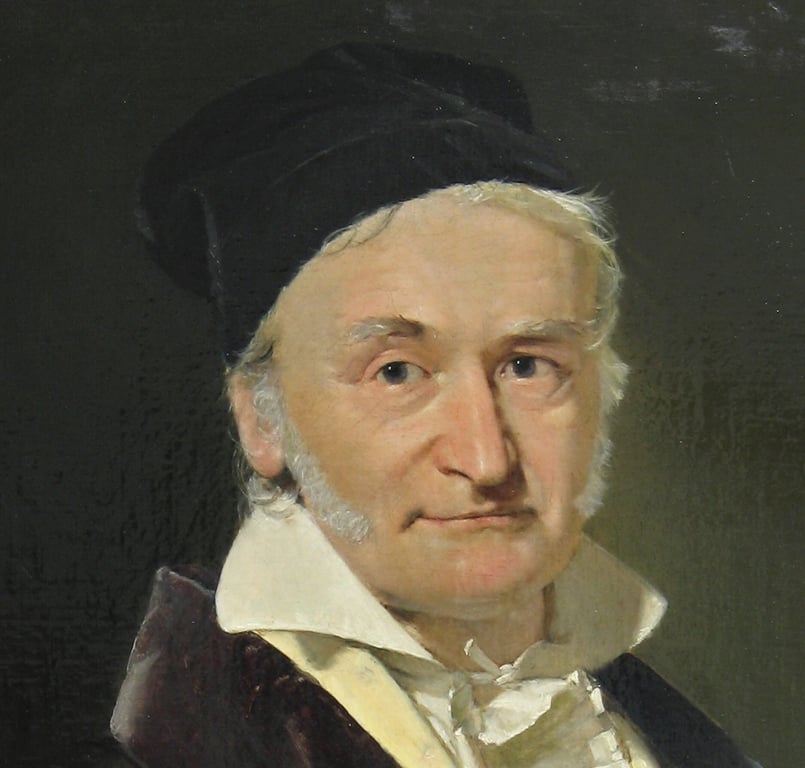
Carl Friedrich Gauss was a German mathematician who made important contributions to various fields, including number theory, algebra, statistics, and astronomy.
Gauss was born on April 30, 1777, in Brunswick, Germany, to poor parents. As a child, he demonstrated notable mathematical abilities, and his potential was recognized by his teachers. At the age of 14, he entered the Collegium Carolinum in Brunswick, where he studied mathematics and other subjects.
Gauss's early work focused on number theory, and he published his first major work, Disquisitiones Arithmeticae, at the age of 21. This work presented a systematic treatment of the theory of numbers and included many important results that would become the foundation of modern number theory.
In addition to his work in number theory, Gauss also made important contributions to other fields of mathematics. He developed the method of least squares, which is widely used in statistics, and he made significant advances in the field of algebra, including the discovery of the fundamental theorem of algebra, which states that every non-constant polynomial equation has at least one complex root.
Gauss also had an interest in astronomy and made important contributions in that field as well. He calculated the orbit of the asteroid Ceres and predicted the position of the planet Neptune, which was later discovered by another astronomer.
Throughout his life, Gauss received numerous honors and awards for his contributions to mathematics and science. He was a member of several prestigious scientific societies, including the Royal Society of London and the French Academy of Sciences. He was also awarded the Order of Merit by the King of Prussia in 1831.
Gauss died on February 23, 1855, in Göttingen, Germany, at the age of 77. His legacy continues to influence mathematics and science to this day.