
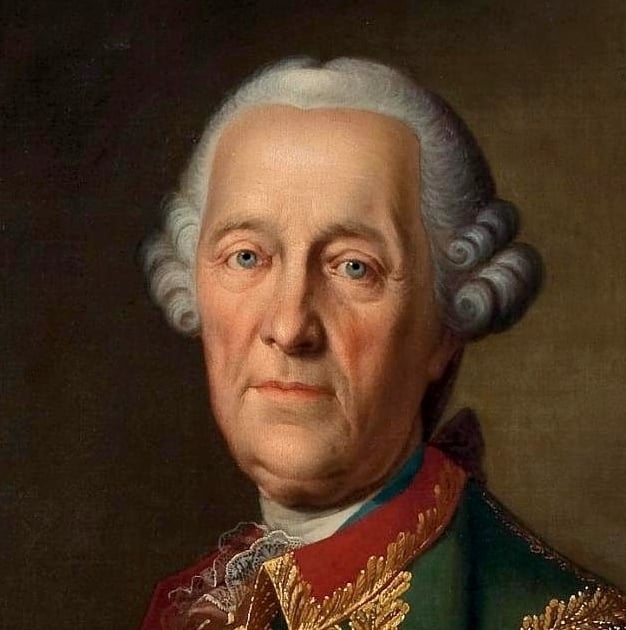
Burkhard Christoph Graf von Münnich was a German-born Russian statesman and military leader who served in the army of Peter the Great and later became a close adviser to Empress Anna Ivanovna.
Münnich was born in Neuenhuntorf, a small village in the principality of East Frisia, which was then part of the Holy Roman Empire. He was the son of a minor nobleman and spent his early years in the court of the Duke of Holstein-Gottorp.
In 1702, at the age of 19, Münnich joined the army of Peter the Great and quickly rose through the ranks due to his military talents and his close relationship with the tsar. He fought in several key battles, including the Battle of Poltava in 1709, which was a turning point in the Great Northern War.
In 1721, Peter the Great appointed Münnich as governor-general of Ingria, a province that included the city of St. Petersburg. During his tenure, he oversaw the construction of several important public buildings, including the first theater in St. Petersburg.
Münnich continued to rise in the ranks of the Russian army and government, and in 1739 he was appointed commander-in-chief of the Russian forces in the war against the Ottoman Empire. Under his leadership, the Russian army won several decisive victories and captured the fortress of Ochakov in 1737.
In 1740, after the death of Empress Anna Ivanovna, Münnich became one of the leading contenders for the throne. However, he was ultimately unsuccessful in his bid for power, and he was arrested and imprisoned in the fortress of Schlüsselburg.
Münnich remained in prison for 11 years, but he was eventually released by Empress Elizabeth in 1756. He spent the rest of his life in retirement, and he died in 1767 at the age of 84.
Burkhard Christoph Graf von Münnich was an important figure in the history of Russia, known for his military leadership, his contributions to the development of St. Petersburg, and his role in the succession struggles of the mid-18th century.