
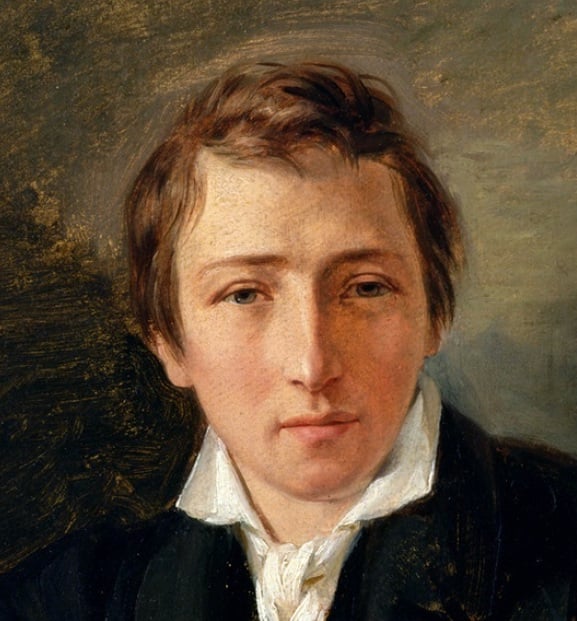
Heinrich Heine was a German poet, journalist, essayist, and literary critic. He was born in Düsseldorf, a town in the Rhineland region of Germany. Heine's parents were Jewish, but he himself converted to Christianity in 1825, possibly to improve his prospects as a writer in anti-Semitic Germany.
Heine began his studies at the University of Bonn in 1815, where he studied law and literature. After moving to the University of Göttingen in 1819, he developed a love for Romantic poetry, particularly the works of Friedrich Schiller and Johann Wolfgang von Goethe. Heine was also influenced by the philosophy of Hegel and the works of Shakespeare.
In 1821, Heine moved to Berlin, where he worked as a journalist and wrote his first book of poetry, Gedichte. This collection established him as a leading figure in the German Romantic movement, and he continued to publish poetry throughout his career.
In addition to his literary work, Heine was also an outspoken critic of the German government and the Church. His views on politics and religion often put him at odds with the authorities, and he was forced to leave Germany in 1831. He spent the rest of his life living in Paris, where he continued to write and publish.
Heine's most famous works include the poetry collections Buch der Lieder and Neue Gedichte, as well as the travelogue Die Harzreise and the novel Florentine Nights. He is known for his innovative use of language and his ability to combine Romanticism with political and social commentary.
Despite his popularity, Heine faced censorship and persecution throughout his career, particularly for his critical views of German society and religion. He died in Paris in 1856, after suffering from a long illness.