
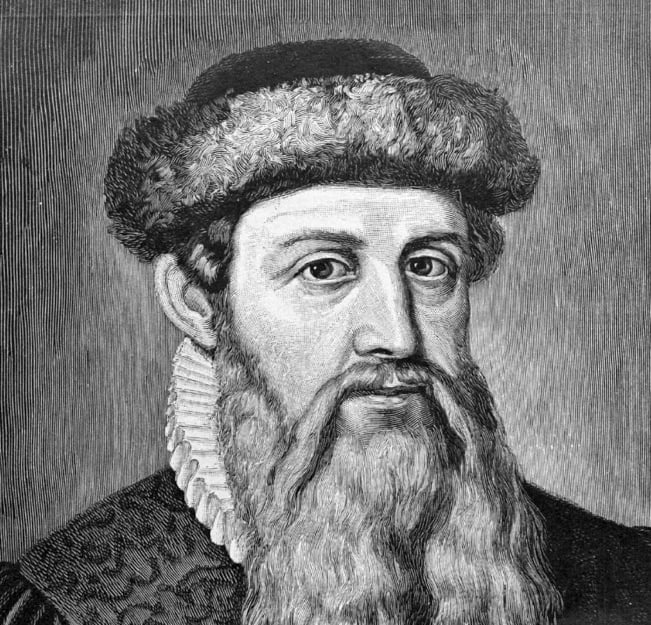
Johannes Gutenberg was a German goldsmith, inventor, and printer who is credited with the invention of the mechanical movable type printing press. His printing press and movable type printing system, which he developed in the 15th century, revolutionized the way books were produced and disseminated, and strongly influenced the development of modern society.
Gutenberg was born in Mainz, Germany around 1394 into a patrician family that had long been involved in the city's politics and commerce. He learned the trade of goldsmithing from his father, and is also believed to have studied at the University of Erfurt.
In the early 1400s, Gutenberg moved to Strasbourg, where he worked as a goldsmith and developed his skills in metalworking, engraving, gem-cutting, and the printing of playing cards, which were a popular form of entertainment at the time.
Gutenberg began working on his printing press and movable type system, which involved the creation of individual pieces of type, each with a raised letter or symbol on it, which could be arranged in a frame to spell out words and sentences. This was a significant improvement over the traditional method of printing, which involved the use of wooden blocks with whole pages of text carved into them. With movable type, it was much easier and faster to produce books, and corrections and revisions could be made much more easily.
Gutenberg's first major publication was a Latin Bible, which he printed in the 1450s. The Bible was a massive undertaking, involving the creation of over 300,000 individual pieces of type. It was a huge success, and helped to establish the printing press as a viable commercial enterprise.
Gutenberg continued to work on his printing press and movable type system throughout the 1450s and 1460s. He produced a number of other important works, including a German Bible and a series of educational texts. However, despite his many achievements, Gutenberg struggled financially for much of his life, and was often forced to borrow money to finance his printing projects.
Gutenberg died in Mainz on February 3, 1468, and was buried in the Franciscan church in the city. His invention strongly influenced the world, and his printing press is considered one of the most important inventions in human history. It allowed for the dissemination of knowledge on a scale never before seen, and paved the way for the scientific, cultural, and political developments that shaped the modern world.