
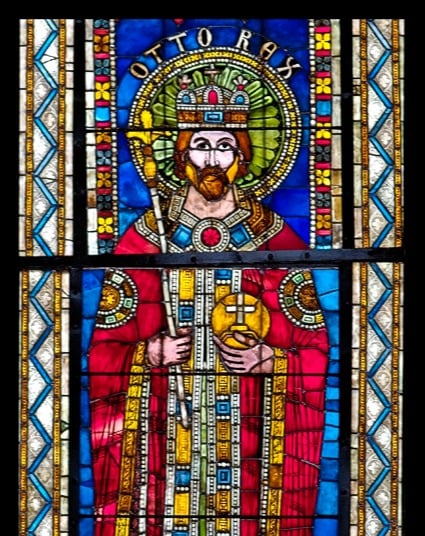
Otto the First, born in 912, was an East Frankish king and Holy Roman Emperor from 962 until his death in 973. Otto inherited the Duchy of Saxony and the kingship of the Germans upon his father's death in 936. He continued his father's work of unifying all German tribes into a single kingdom and expanded the king's powers at the expense of the aristocracy.
Through strategic marriages and personal appointments, Otto installed members of his family in the kingdom's most important duchies. This reduced the various dukes, who had previously been co-equals with the king, to royal subjects under his authority. Otto transformed the church in Germany to strengthen royal authority and subjected its clergy to his personal control.
Otto was a great military commander and strategist, and his victory against the Magyars at the Battle of Lechfeld in 955 was a major achievement, ending the Hungarian invasions of Western Europe. This earned him a reputation as a saviour of Christendom and secured his hold over the kingdom. By 961, Otto had conquered the Kingdom of Italy and was crowned emperor in 962 by Pope John XII in Rome.
Otto's reign was not without challenges. He faced conflicts with the papacy and struggled to stabilize his rule over Italy. Reigning from Rome, Otto sought to improve relations with the Byzantine Empire, which opposed his claim to emperorship and his realm's further expansion to the south. Despite these challenges, Otto was a successful ruler, and his strong character and fruitful initiatives are still admired by historians today.
Otto's legacy is not limited to his political achievements. He also played an important role in the arts and architecture of his time. His patronage facilitated a so-called "Ottonian Renaissance" of arts and architecture, marking the start of new, vigorous literary traditions.
Otto the Great left a strong mark on European history, especially in politics, military strategy, and the arts. His achievements continue to be studied by historians and art historians.