
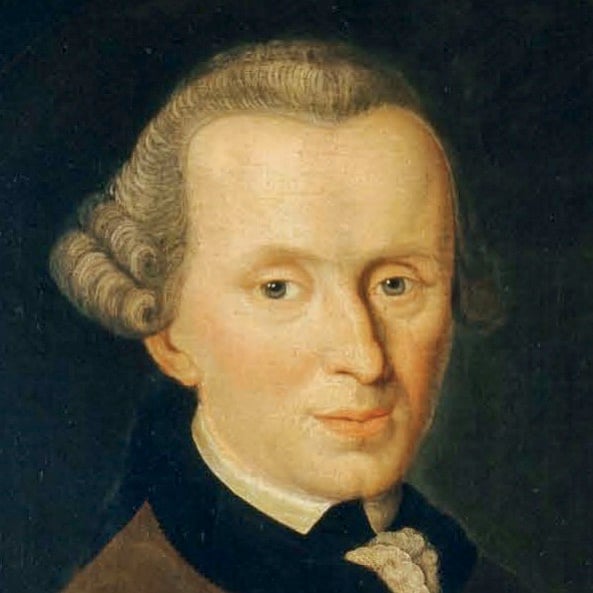
Immanuel Kant was a German philosopher who has been widely recognized as one of the most important figures in the history of Western philosophy. He made important contributions to the areas of epistemology, metaphysics, ethics, and aesthetics.
Kant was born in Königsberg Prussia to a family of humble means. He received his early education at a Pietist school, where he was taught strict moral principles and a rigorous work ethic.
Kant's philosophy is characterized by his notion of the categorical imperative, which he introduced in his work Groundwork of the Metaphysics of Morals. According to Kant, the categorical imperative is a universal moral law that all rational beings must follow regardless of their personal desires or interests. This law states that one should always act in such a way that the maxim of one's action could become a universal law of nature.
Kant's epistemology argued that our knowledge of the world is shaped by the categories of the mind which are innate structures that allow us to organize and interpret our sensory experiences. In other words, our understanding of reality is not simply a reflection of the external world, but is also shaped by our own mental frameworks.
Kant's work in metaphysics was groundbreaking and he rejected the traditional distinction between appearance and reality, arguing that the world as we experience it, is the only world that we can know. He also introduced the idea of the transcendental, which refers to the necessary conditions that must be present for us to have any experience of the world at all.
In addition to his contributions to philosophy, Kant was also an influential figure in the fields of aesthetics and political theory. His ideas about the nature of beauty and the role of art in society have had a lasting influence on the way we think about these topics today.