
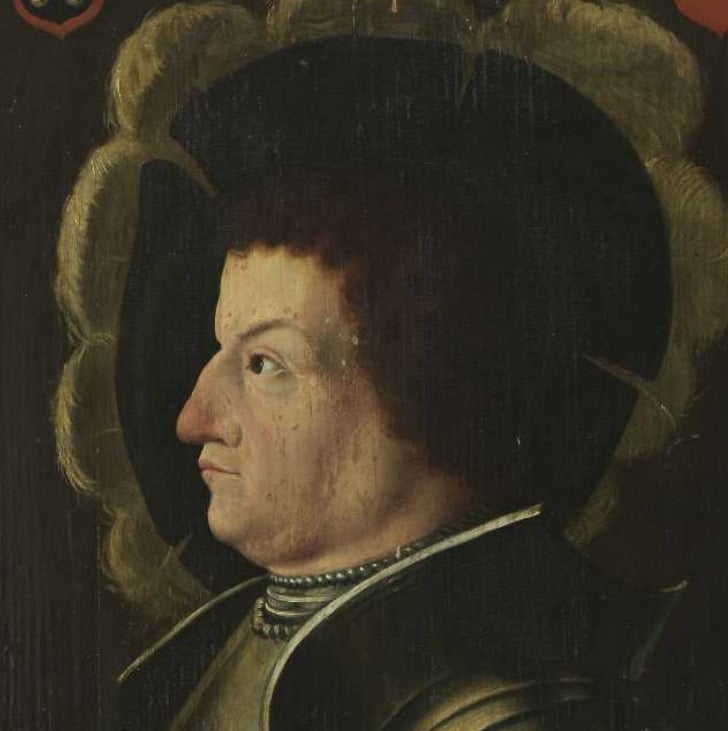
Franz von Sickingen was a German knight, born on March 2, 1481 in Ebernburg, a small village in the Rhineland-Palatinate region of Germany. He is often considered as one of the most important figures of the German Renaissance period, particularly for his role in the Imperial Knights' Revolt against the Holy Roman Empire.
Sickingen was born into a noble family, and his father, Hans von Sickingen, was a knight and a loyal supporter of the Elector Palatine, Frederick III. Growing up, Sickingen received an excellent education, studying theology, law, and other subjects, which he would later use to his advantage as a military commander and diplomat.
At the age of 19, Sickingen inherited his father's estates and titles, including the castle of Landstuhl, which he used as his base of operations. He became known as a skilled military strategist and tactician, and his reputation as a fearless warrior soon spread throughout Germany.
In 1507, Sickingen became embroiled in a feud with the Archbishop of Trier, Richard von Greiffenklau zu Vollrads. The dispute arose over a disputed piece of land near Sickingen's castle, which the Archbishop claimed belonged to him. Sickingen refused to back down, and the conflict escalated into a full-blown war between the two sides. Sickingen emerged victorious, and the Archbishop was forced to pay a large sum of money in compensation.
After this victory, Sickingen continued to expand his influence and power, forging alliances with other knights and nobles across Germany. He became a vocal advocate for the rights of the Imperial Knights, who were a class of nobles that owed their allegiance directly to the Holy Roman Emperor and were exempt from many of the laws and regulations that governed other nobles.
In 1522, Sickingen led a group of knights in a rebellion against the Archbishop of Trier, who had become one of his main rivals. The revolt quickly spread to other parts of Germany, as other knights and nobles joined the cause. However, the rebellion was eventually suppressed by the forces of the Holy Roman Empire, and Sickingen was forced to flee to his castle at Landstuhl.
In 1523, Sickingen launched a final, desperate attack against the city of Trier, hoping to recapture his lost territory and reassert his authority in the region. However, the attack failed, and Sickingen was fatally wounded in the fighting. He died on May 7th, 1523, at the age of 42.
Despite his ultimately unsuccessful rebellion, Sickingen is still remembered as a heroic figure in German history, who stood up for the rights of the Imperial Knights and fought to defend his own lands and people against the powerful forces of the Holy Roman Empire.