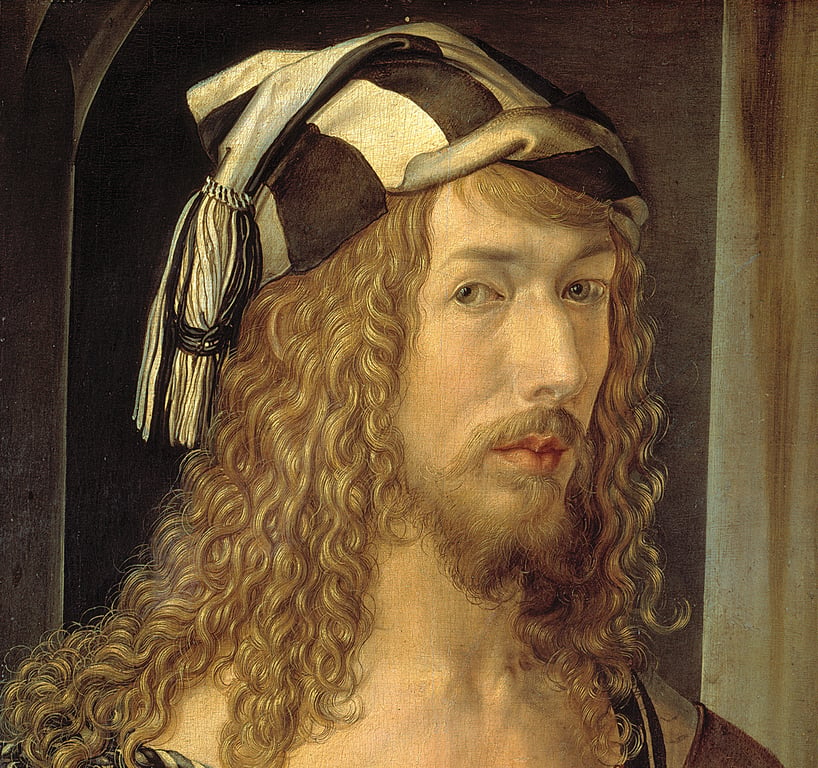
Albrecht Dürer was a famous German painter, printmaker, and mathematician who is widely regarded as one of the greatest artists of the Northern Renaissance. He was born in Nuremberg, Germany, in 1471, and spent most of his life there, where he created many of his most famous works.
Dürer began his artistic training at the age of 15, working as an apprentice to his father, who was a goldsmith. He soon showed a talent for drawing and painting and went on to study under the leading Nuremberg artist Michael Wolgemut.
Dürer's early works included woodcuts and engravings that depicted religious themes and scenes from everyday life. He quickly gained a reputation as a master of these techniques and began to receive commissions from wealthy patrons across Europe.
Dürer's most famous works include his series of woodcuts known as the Apocalypse, which depict scenes from the Book of Revelation, and his engraving of Adam and Eve, which is considered one of the greatest masterpieces of the Renaissance. He also created a number of famous portraits, including those of his contemporaries, such as Erasmus of Rotterdam and Emperor Maximilian I.
In addition to his artistic pursuits, Dürer was also a mathematician and wrote extensively on the subject. He published several treatises on geometry and perspective, which were highly influential in the development of modern mathematics.
Dürer was also an important figure in the Protestant Reformation and was known for his support of Martin Luther's teachings. He corresponded with Luther and other leading reformers and created several works that expressed his support for the Reformation.
Albrecht Dürer died in Nuremberg in 1528 at the age of 56, leaving behind a legacy of artistic and intellectual achievement that has continued to inspire and influence artists and thinkers to this day.