
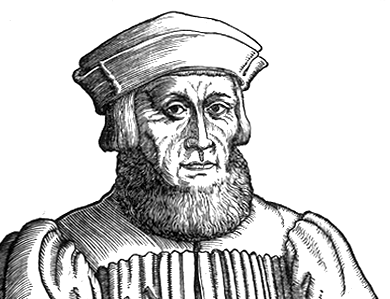
Aventin, whose real name was Johann Turmair, was a German humanist, historian, and theologian of the early 16th century. He was born in Abensberg, Bavaria, in 1477, and spent most of his life in the city of Ingolstadt, where he became a respected figure in the intellectual circles of his time.
Aventin received his early education at the University of Ingolstadt, where he studied theology, philosophy, and the classics. He later traveled to Italy, where he continued his studies at the University of Padua and became acquainted with some of the leading humanists of the Italian Renaissance.
Upon his return to Ingolstadt, Aventin became a professor at the university and began to write extensively on a wide range of topics, including history, theology, and law. He was a prolific author, and his works include a history of Bavaria, a collection of sermons, and several treatises on law and politics.
One of Aventin's most important contributions was his role in the development of German humanism. He was part of a group of scholars who sought to revive interest in the classics and to promote the use of the German language in scholarly works. Aventin himself wrote many of his works in German, which was an unusual practice for the time.
Aventin was also an important figure in the Protestant Reformation, and he became a close friend and advisor to Martin Luther. He was an outspoken critic of the Catholic Church's corruption and abuses of power, and his works played an important role in shaping the intellectual climate that led to the Reformation.
Despite his many accomplishments, Aventin's legacy was somewhat overshadowed by his controversial political views. He was a strong advocate of Bavarian independence, and his writings often expressed anti-imperial sentiments that put him at odds with the rulers of the Holy Roman Empire. As a result, Aventin was frequently embroiled in political controversies, and he was eventually exiled from Bavaria in 1522. He returned to Ingolstadt in 1524, where he remained until his death in 1534.
In conclusion, Aventin was a highly influential figure in the intellectual and cultural history of early modern Germany. He was a pioneer of German humanism, a prominent historian and theologian, and a key figure in the Protestant Reformation. Despite his political controversies, his works continue to be studied and admired to this day.