
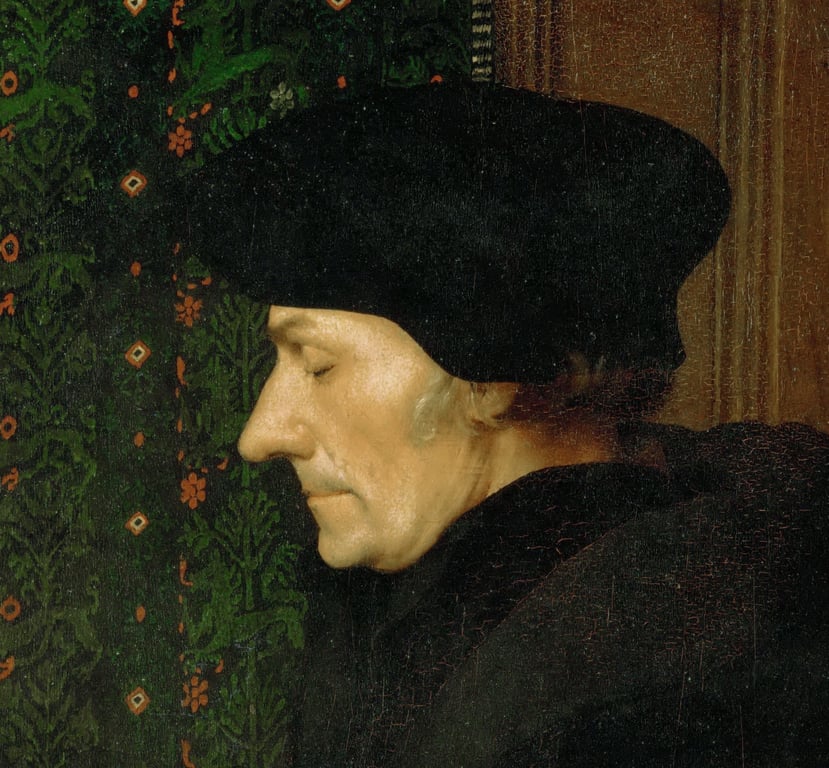
Erasmus of Rotterdam was a Dutch philosopher, theologian, writer, and scholar of the Renaissance period. He was born in Rotterdam, Netherlands, around 1466. His parents, Gerard and Margaret, were not married, and Erasmus grew up with his mother in poverty.
Erasmus received his education in a monastery school and then attended the University of Paris, where he studied theology, Latin, and Greek. He became fluent in Greek, which was a rare skill at the time, and used his knowledge of the language to translate the New Testament from Greek into Latin. This translation became known as the "Erasmus Bible" and was widely used throughout Europe.
In addition to his theological work, Erasmus was also a prolific writer on a wide range of topics, including politics, education, and classical literature. One of his most famous works was "The Praise of Folly," a satirical essay that criticized the hypocrisy and corruption of the Catholic Church.
Erasmus was a major figure in the humanist movement of the Renaissance, which emphasized the importance of human values, reason, and education. He believed that the study of classical literature and philosophy could help people lead more virtuous lives and create a more just society.
Erasmus was also a supporter of religious reform, although he did not break with the Catholic Church like Martin Luther did. He criticized many aspects of the Church, such as the sale of indulgences, but believed that reform could be achieved from within the Church itself.
Erasmus died in Basel, Switzerland, in 1536. His work had a significant impact on the intellectual and cultural life of Europe during the Renaissance and beyond.