
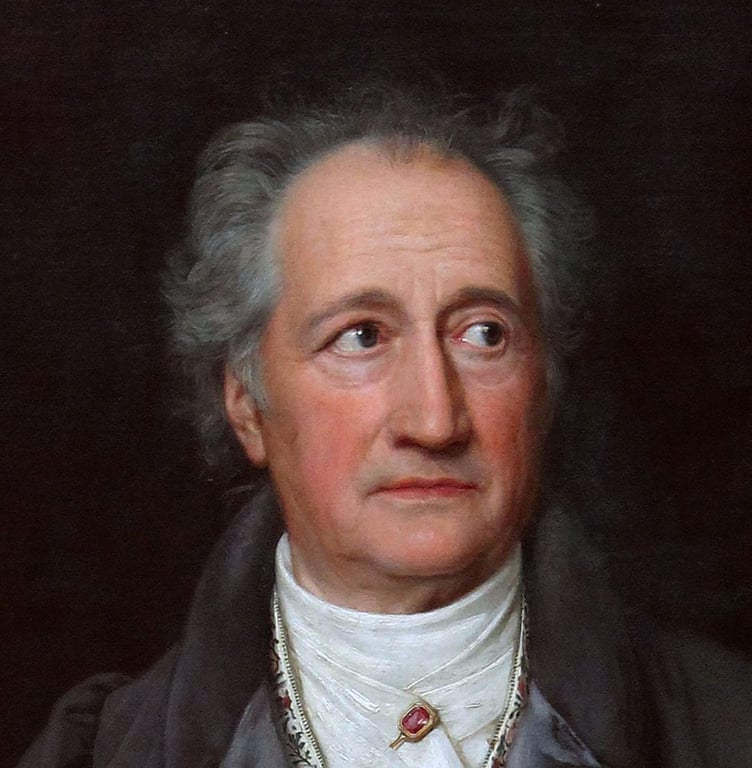
Johann Wolfgang von Goethe was a German writer, poet, and polymath who made important contributions to literature, science, and philosophy. He is widely regarded as one of the greatest literary figures in Western culture and is often referred to as the Shakespeare of German literature.
Goethe was born in Frankfurt, Germany in 1749, to a wealthy family. He received a comprehensive education in languages, music, literature, and science, and showed an early interest in literature and poetry. In 1765, he began studying law at the University of Leipzig but soon abandoned his studies to pursue his passion for writing.
Goethe's literary career began with the publication of his first novel, "The Sorrows of Young Werther," in 1774. The novel, which tells the story of a young man's unrequited love, became an instant success and made Goethe a literary celebrity. He went on to write many other works, including the epic poem "Faust," which he worked on for over 60 years, and is considered one of the greatest works in Western literature.
In addition to his literary achievements, Goethe was also interested in science and made important contributions to the fields of botany, zoology, and optics. He conducted experiments on plant morphology and published his findings in "The Metamorphosis of Plants", a work that influenced the development of the science of plant morphology.
Goethe was also interested in philosophy and developed his own system of thought, which he called "Wilhelm Meister's Apprenticeship." The system emphasizes the development of the individual's character and the pursuit of a harmonious life.
Goethe's legacy continues to influence literature, science, and philosophy. His works have been translated into many languages and continue to be read and studied around the world. His impact on German culture is so great that the period of German literature from 1770 to 1830 is often referred to as the "Goethezeit," or the Age of Goethe.