
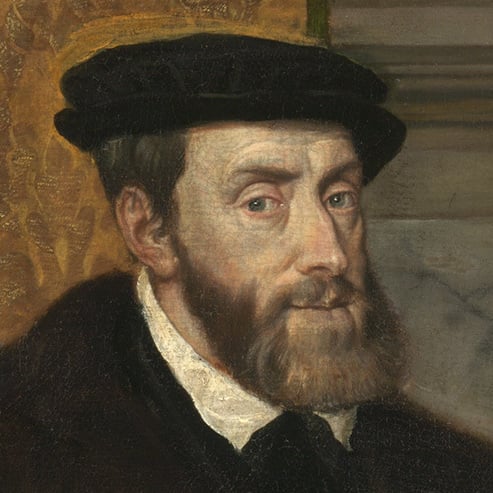
Karl V., also known as Charles V, was the Holy Roman Emperor from 1519 until his abdication in 1556. He was born in Ghent, Flanders, which was then part of the Burgundian Netherlands. Karl V was the son of Philip the Handsome, Duke of Burgundy, and Joanna the Mad, Queen of Castile. His paternal grandparents were the Holy Roman Emperor Maximilian I and Mary of Burgundy.
Karl V was educated by the best teachers of his time and was fluent in several languages, including Dutch, French, German, Italian, and Spanish. He became the ruler of the Habsburg Empire at the young age of 16, inheriting a vast empire that included Spain, the Spanish Empire in the Americas, and the Netherlands.
Karl V faced many challenges during his reign, including the Protestant Reformation, the Ottoman Turks, and the rivalry with France. He was a devout Catholic and saw the spread of Protestantism as a threat to his authority and the unity of his empire. To counter this, he sought to maintain a strong and centralized Catholic Church and engaged in wars against Protestant leaders, such as the Schmalkaldic War in Germany.
Karl V also faced threats from the Ottoman Turks, who were expanding their empire into Europe. He led several campaigns against the Ottomans, including the Battle of Mohács in 1526 and the Siege of Vienna in 1529, both of which were successful in repelling the Ottoman forces.
Karl V's rivalry with France led to several wars, including the Italian Wars and the Habsburg-Valois Wars. The most important of these was the Thirty Years' War, which began in 1618 and ended with the Peace of Westphalia in 1648.
Despite his many achievements, Karl V faced personal challenges, including a lifelong struggle with gout and the stress of ruling a vast empire. He abdicated his throne in 1556, dividing his empire between his son, Philip II of Spain, and his brother, Ferdinand I, who became the Holy Roman Emperor.
Karl V is remembered as one of the most powerful and influential monarchs in European history, who presided over an era of great change and upheaval. His legacy includes his efforts to maintain a centralized Catholic Church and his role in the struggle against the Protestant Reformation, as well as his successful campaigns against the Ottoman Turks and his rivalry with France.