
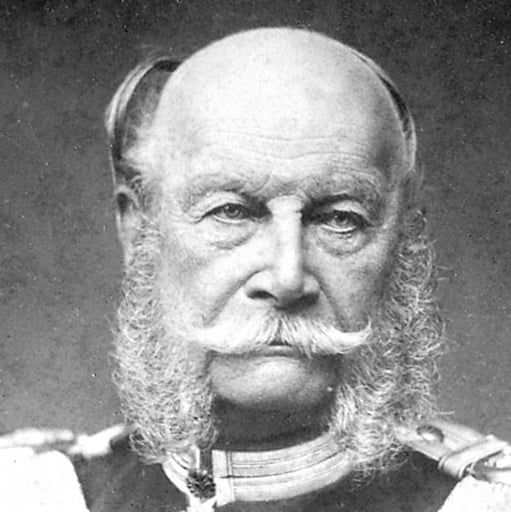
Wilhelm I was the King of Prussia from 1861 until his death in 1888, and the first German Emperor from 1871 to 1888. He was born on March 22, 1797, in Berlin, Prussia, and was the eldest son of King Frederick William III of Prussia and Queen Louise.
Wilhelm I played an important role in the unification of Germany. In 1862, he appointed Otto von Bismarck as Prime Minister of Prussia, who would later become his close advisor and a key figure in the unification of Germany. In 1866, Prussia fought and won a brief war against Austria, which weakened the Austrian Empire's influence in Germany and paved the way for the establishment of a unified German state.
On January 18, 1871, in the Hall of Mirrors at the Palace of Versailles in France, Wilhelm I was proclaimed the first German Emperor, marking the culmination of the unification of Germany. Wilhelm I was crowned by the Prussian Chancellor Otto von Bismarck as the first German Emperor, with the Kingdom of Prussia at the center of the newly formed German Empire.
During his reign as German Emperor, Wilhelm I was known for his strong leadership and his military successes, particularly in the Franco-Prussian War of 1870-1871. The war resulted in the defeat of France and the annexation of the French provinces of Alsace and Lorraine to the German Empire.
Wilhelm I was also known for his conservative political views and his commitment to the ideals of Prussian militarism. He supported the expansion of the German military and advocated for a strong, centralized government.
Wilhelm I died on March 9, 1888, in Berlin, at the age of 90. He was succeeded by his son, Friedrich III, who reigned for only a few months before his own death, after which Wilhelm I's grandson, Wilhelm II, became the new German Emperor.