
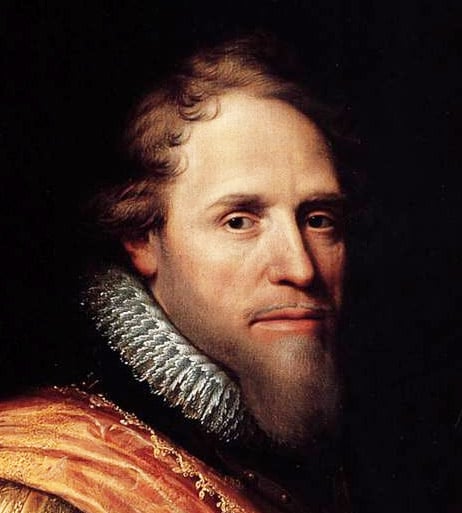
Prinz Moritz von Orange was a Dutch military leader and politician who played an important role in the Dutch War of Independence against Spain. He was born in Dillenburg, Germany, the second son of William the Silent, Prince of Orange, and his first wife Anna of Egmond.
Moritz was educated in Leiden and became interested in military strategy at an early age. He joined the Dutch army at the age of 18 and quickly rose through the ranks. He was appointed captain of a cavalry unit in 1588 and led successful campaigns against the Spanish in the Netherlands.
Moritz's greatest military success came in 1597 when he defeated a Spanish army at the Battle of Turnhout. He used innovative tactics, such as using mobile cavalry units and artillery, to overcome the Spanish forces. This victory made him a national hero in the Netherlands.
In addition to his military career, Moritz was also involved in politics. He was appointed stadtholder of the provinces of Gelderland, Overijssel, and Utrecht in 1587 and later became stadtholder of Groningen, Drenthe, and Friesland. He played an important role in consolidating the power of the Dutch Republic and helped to establish its independence from Spain.
Moritz was also known for his artistic and cultural interests. He was a patron of the arts and supported many painters, poets, and musicians. He was particularly interested in music and played several instruments, including the lute and the harpsichord.
Despite his many accomplishments, Moritz was not without controversy. He had a strained relationship with his older brother, Philip William, and was accused of conspiring to have him assassinated. He also clashed with other Dutch leaders over issues of religion and political power.
Moritz died in The Hague in 1625 at the age of 58. He was buried in the New Church in Delft, alongside his brother and other members of the House of Orange.