
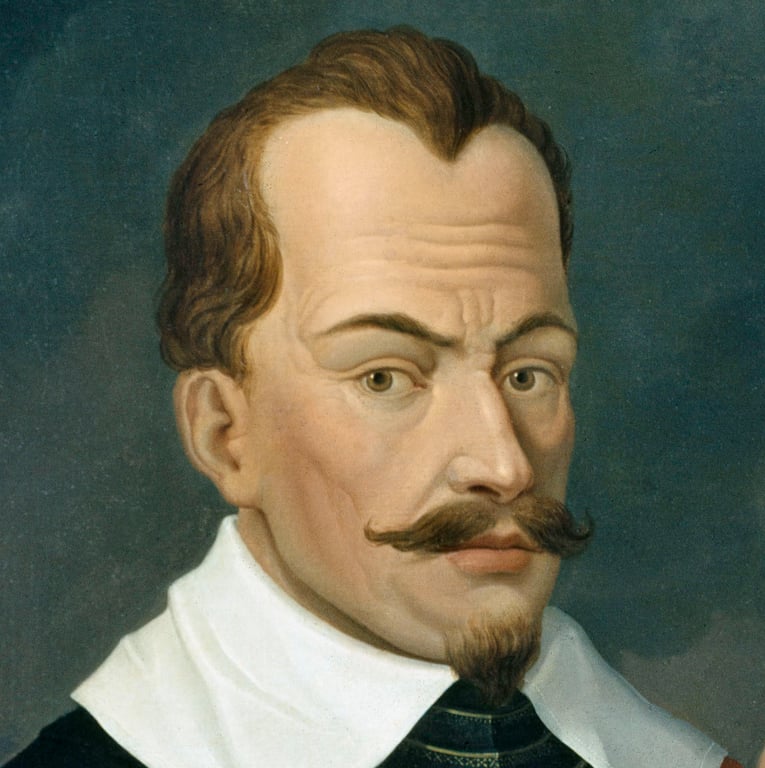
Albrecht von Wallenstein was a military commander and politician during the Thirty Years' War in Europe. Born in Bohemia, Wallenstein was the son of a wealthy Protestant merchant family. He received a good education and showed an early interest in military affairs.
Wallenstein rose to prominence in the early stages of the Thirty Years' War, serving as a commander for the Catholic Habsburgs. He quickly distinguished himself as a skilled strategist and tactician, winning several important battles against Protestant forces. In 1625, he was appointed as the supreme commander of the Habsburg army.
As commander-in-chief, Wallenstein was responsible for directing the Habsburg war effort against the Protestant powers. He employed innovative tactics and strategies, such as using mobile cavalry units to raid enemy supply lines and disrupt their communications. He also introduced new methods of training and equipping soldiers, which helped to improve the overall effectiveness of the Habsburg army.
Despite his military successes, Wallenstein was a controversial figure. He was known for his ambition and ruthless tactics, and his political views sometimes clashed with those of the Habsburgs. In 1630, he was dismissed from his position as commander-in-chief, allegedly due to suspicions that he was plotting against the Habsburg emperor.
Wallenstein's dismissal did not mark the end of his involvement in the war. He continued to play an active role in politics and military affairs, and in 1632 he was reinstated as commander-in-chief. However, his second tenure was short-lived. In 1634, he was assassinated by a group of Habsburg officers who feared his growing power and influence.
Wallenstein's legacy is a subject of debate among historians. Some see him as a brilliant military commander who revolutionized warfare, while others view him as a ruthless opportunist who put his own interests ahead of those of his country. Nonetheless, his impact on the Thirty Years' War and on military history in general is undeniable.