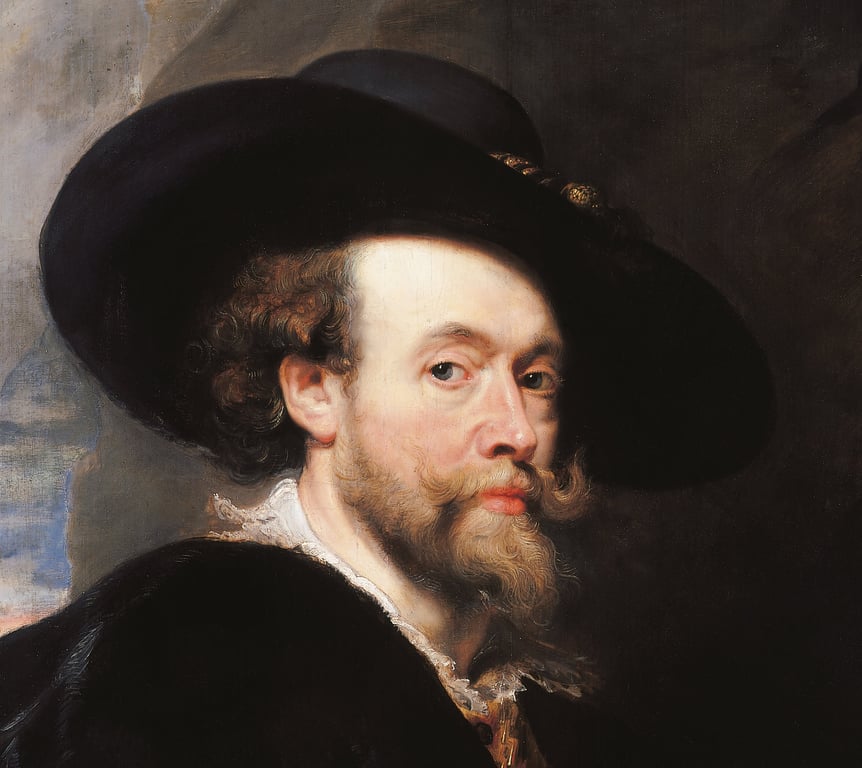
Peter Paul Rubens was a Flemish Baroque painter and diplomat known for his dynamic and sensual style of art. He was born in Siegen, Westphalia, in modern-day Germany, to Jan Rubens and Maria Pypelincks. His father, a lawyer, fled Antwerp to escape persecution for his involvement in a political scandal, and the family settled in Cologne.
Rubens received his education in Antwerp, where he studied under various artists, including Otto van Veen. He also traveled to Italy, where he was inspired by the works of Michelangelo, Raphael, and Caravaggio. In 1600, he returned to Antwerp and established his studio, where he employed many assistants and collaborators.
Rubens' artistic style was characterized by his use of dynamic movement, rich color, and dramatic lighting. His subjects ranged from historical and mythological scenes to portraits and landscapes. He was also a skilled draftsman and created many sketches and studies for his paintings.
In addition to his artistic career, Rubens was also a diplomat. He was appointed as a court painter by Archduke Albert of Austria in 1603 and later served as a diplomat for the Spanish Netherlands. He used his diplomatic skills to negotiate the end of the Thirty Years' War, which led to the signing of the Peace of Westphalia in 1648.
Rubens' legacy as an artist has endured for centuries. His works can be found in museums and collections around the world, and his influence can be seen in the works of many later artists. His style of art, known as the Rubenesque, is characterized by voluptuous figures and sensuality.
Despite his success, Rubens suffered from gout and other health problems in his later years. He died in Antwerp in 1640 at the age of 63. He was buried in the Church of St. James, which he had helped to rebuild.