
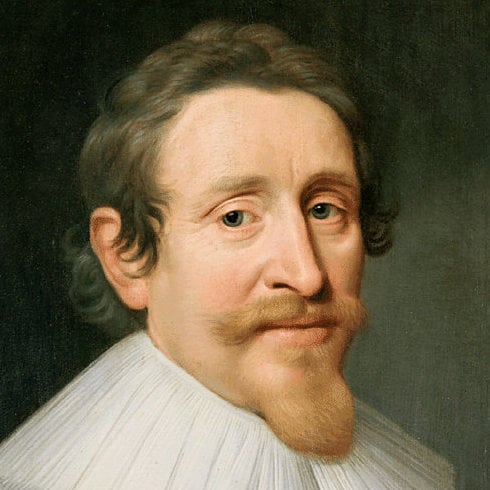
Hugo de Groot, also known as Hugo Grotius, was a Dutch jurist, philosopher, and statesman. He was born in Delft, the Netherlands, to a prominent family of scholars and theologians. Hugo de Groot received a rigorous education in classical languages, philosophy, and theology, which laid the foundation for his lifelong interests in law and politics.
As a young man, Hugo de Groot showed great intellectual promise and quickly gained recognition as a legal scholar. In 1608, he published his first major work, "De Jure Praedae", which dealt with the legal principles governing the capture of enemy ships and property during times of war. This work brought him to the attention of the Dutch government, and he was appointed as an advocate to the Court of Holland in 1609.
In the following years, Hugo de Groot became increasingly involved in Dutch politics, serving as a legal advisor and diplomat to the government. In 1613, he was appointed as the official historian of the Dutch Republic, a position he held for the rest of his life. He was also instrumental in negotiating the Twelve Years' Truce between the Dutch Republic and Spain in 1609.
However, Hugo de Groot's political career came to an abrupt end in 1618, when he was accused of being a supporter of the Arminian heresy, which was considered a threat to the Dutch Reformed Church. He was arrested and imprisoned in the castle of Loevestein, where he remained for over a year. It was during this period of confinement that he wrote his most famous work, "De Jure Belli ac Pacis", which is considered one of the founding works of modern international law.
In 1621, Hugo de Groot managed to escape from his captivity by hiding in a chest and being smuggled out of the castle by his wife. He fled to France, where he lived in exile for the rest of his life. He continued to write and publish works on law, politics, and theology, and he remained an influential figure in European intellectual circles until his death in Rostock, Germany, in 1645.
Hugo de Groot's legacy as a legal scholar and statesman continues to be felt today, particularly in the field of international law. His works on the laws of war and peace, and his belief in the importance of natural law, helped to shape the modern concept of human rights and the role of international law in regulating the conduct of states.