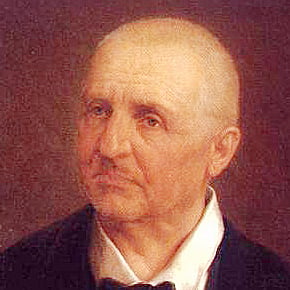
Anton Bruckner was an Austrian composer and organist of the Romantic era. Born in Ansfelden, Austria, Bruckner was the eldest of eleven children. His father, Anton Bruckner Sr., was a schoolteacher and his mother, Theresia, was a homemaker.
Bruckner's childhood was marked by poverty and hardship, but he showed an early talent for music. He began his musical studies at the age of eleven, learning to play the organ from local church musicians. In 1837, he was accepted as a choirboy at St. Florian Abbey, where he received a rigorous musical education and developed a lifelong devotion to the works of Johann Sebastian Bach.
After completing his studies at St. Florian, Bruckner worked as an assistant teacher and organist in various small towns in Austria. In 1855, he moved to Vienna to study with the famous composer and conductor Otto Kitzler. During this time, he also took lessons from Simon Sechter, a well-known music theorist who would become a major influence on his compositional style.
Bruckner's early compositions were mainly choral works and chamber music, but he soon began to focus on orchestral compositions. His breakthrough came in 1868 with the premiere of his Symphony No. 1 in C minor, which was met with critical acclaim. This success allowed him to secure a position as a professor of harmony and counterpoint at the Vienna Conservatory, where he would remain for the rest of his life.
Bruckner's compositional style was deeply influenced by his religious faith and his love of the music of Bach. His symphonies are known for their grandeur and complexity, with intricate counterpoint and the use of multiple themes. He was also noted for his use of brass instruments, which he used to create powerful and dramatic climaxes.
Despite his success as a composer, Bruckner was often criticized by contemporary critics for his unconventional harmonic language and the length of his symphonies. However, his music has since been recognized as a major contribution to the Romantic era and his symphonies are performed and recorded regularly.
Bruckner died in Vienna in 1896 and was buried at St. Florian Abbey, where he had spent his formative years as a musician.