
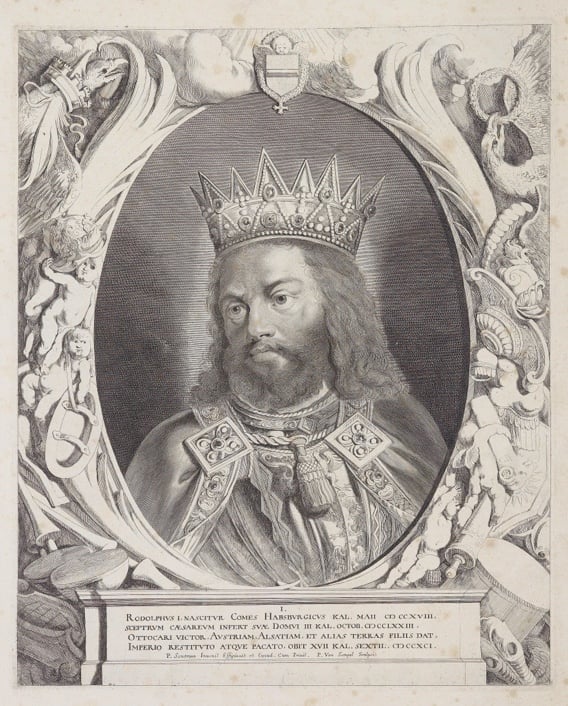
Rudolf I of Habsburg, born in 1218, in the town Limburg an der Lahn, was a member of the House of Habsburg, a noble family in medieval Europe. He is known as the first King of the Romans, later renamed Holy Roman Emperor, after his election in 1273 following a period of political instability in the Holy Roman Empire.
Prior to his election, Rudolf was a powerful regional lord in what is now Austria and Switzerland. He inherited a significant amount of land from his father and expanded his holdings through strategic marriages and military campaigns. He also supported the Catholic Church and worked with Pope Gregory X to promote religious unity and suppress heresy.
Rudolf's election as King of the Romans was a significant moment in European history. The Holy Roman Empire had been in decline for several decades, and Rudolf I's election marked a shift towards a more centralized monarchy. During his reign, he faced many challenges such as rebellions by regional lords, conflicts with neighbouring states, and the threat of the Mongol Empire. Nevertheless, he was able to maintain peace and stability in the empire and set the foundation for future rulers to build upon.
Rudolf was known for his military prowess, patronage of the arts and sciences, and commissioning several important buildings, including the Habsburg Castle. He was married twice and had several children, including Albrecht I, who succeeded him as King of the Romans.
Today, Rudolf I is remembered as a pivotal figure in European history, whose legacy as the first King of the Romans helped to restore order and stability to the Holy Roman Empire during a time of great turmoil.