
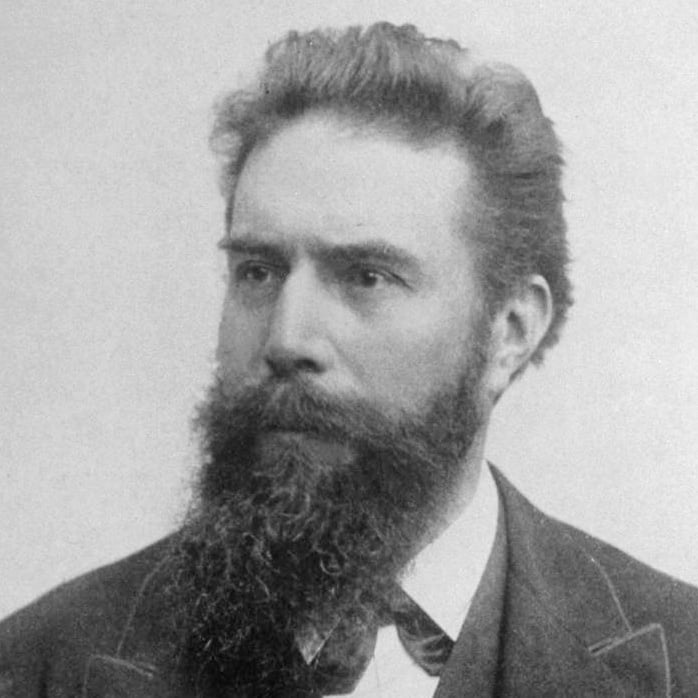
Wilhelm Conrad Röntgen was a German physicist who made one of the most important scientific discoveries in history: X-rays. Röntgen was born in Lennep, Prussia in 1845. His father was a cloth merchant, and his mother was the daughter of a wealthy industrialist.
Röntgen received his early education in Holland and then attended the Polytechnic in Zurich, Switzerland, where he studied mechanical engineering. After completing his studies, Röntgen became an assistant to August Kundt, a physicist who was conducting research on the properties of gases. Röntgen worked with Kundt for several years, and during this time, he began to develop an interest in the newly discovered phenomena of cathode rays.
In 1895, Röntgen was experimenting with cathode rays when he made his groundbreaking discovery. While conducting experiments on a vacuum tube, he noticed that a piece of paper coated with a fluorescent material began to glow when the tube was energized. He realized that something invisible was passing through the tube and causing the paper to glow. After further experimentation, Röntgen discovered that these invisible rays could penetrate through different materials, including human flesh.
Röntgen had discovered X-rays, which would become one of the most valuable tools in the medical profession. His discovery allowed doctors to see inside the human body without the need for invasive surgery. This discovery earned Röntgen the Nobel Prize in Physics in 1901.
Despite the significance of his discovery, Röntgen remained humble and continued to work as a professor of physics at the University of Munich until his retirement in 1920. He died on February 10, 1923, in Munich, Germany.