
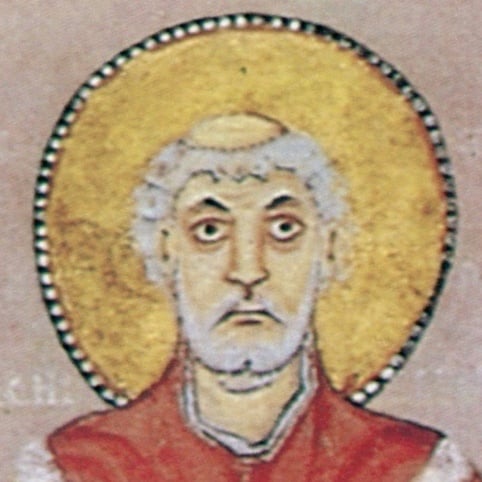
Willibrord was a Northumbrian missionary and bishop who played an important role in spreading Christianity among the Frisians and other Germanic tribes in the early medieval period.
Born around 658 Willibrord was the son of Wilgils, a nobleman. He was placed in the care of the monastic community at Ripon as a young child and later educated at the Abbey of Rath Melsigi in Ireland, where he spent twelve years studying under St. Egbert.
In 690, at the age of 32, Willibrord embarked on a mission to Christianize the Frisians, a Germanic people living in the region that today encompasses parts of the Netherlands and Germany. This mission was in part motivated by the growing influence of the Roman Church and the desire to establish new religious centers beyond the boundaries of the existing Christian territories.
In 695, Willibrord was consecrated as a bishop by Pope Sergius I, who gave him the name Clement. With the support of Pepin of Herstal, Willibrord established his base at Utrecht, where he founded a church and a monastery. This city would later become a significant center for the propagation of Christianity throughout the region.
Willibrord's missionary work extended beyond the Frisians to other Germanic tribes, such as the Saxons and the Danes. He is known to have traveled extensively throughout the region, baptizing converts, building churches, and appointing priests to support the growth of the Christian faith.
He supported Charles Martel's efforts to suppress the Frisian uprising led by the pagan leader Radbod. He also maintained close relations with the Carolingian rulers, who offered him protection and support throughout his missionary career.
Willibrord died in 739 at the age of 81 in the monastery of Echternach, which he had founded in 698. He is buried in the church there, and his tomb has become a place of pilgrimage. Willibrord was canonized as a saint by the Roman Catholic Church, and his feast day is celebrated on November 7.