
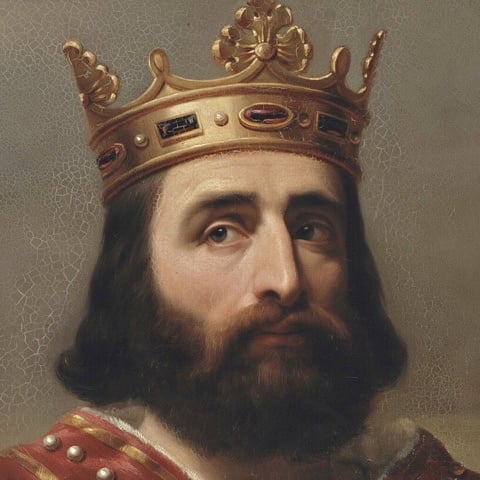
Pippin the Younger was a important figure in Frankish and European history who ruled as King of the Franks from 751 to 768. Born in 714, he was the son of Charles Martel, a powerful military leader who halted the advance of Muslim forces in Europe during the Battle of Tours in 732. Pepin the Short was also the father of Charlemagne, who would later unite much of Western and Central Europe under his rule as the first Holy Roman Emperor.
Pepin began his career under the reign of his father, Charles Martel, serving as the Mayor of the Palace, an influential position in the Merovingian dynasty, which ruled the Frankish Kingdom at the time. The Merovingian kings had become weak figureheads, while the true power was wielded by the Mayors of the Palace. When Charles Martel died in 741, he left the position of Mayor of the Palace to his sons, Pepin and Carloman. The brothers jointly ruled the kingdom, with Pepin overseeing the northern territories and Carloman the southern ones.
However, Carloman decided to abdicate his position and enter a monastery in 747, leaving Pepin as the sole ruler. In 751, Pepin took a crucial step in consolidating his power by deposing the last Merovingian king, Childeric III, and becoming the first king of the Carolingian dynasty. He sought the approval of Pope Zachary to legitimize his rule, and the Pope consented. Pepin was anointed king by Saint Boniface, which further strengthened his position as the rightful ruler.
Pepin conducted several successful military campaigns during his reign. He fought against the Lombards, a Germanic tribe that threatened the Papacy, as well as against Muslim forces in Septimania and the Iberian Peninsula. Pepin's victories over the Lombards in Italy led to the creation of the Papal States, a gift of conquered territories to Pope Stephen II, which established a strong alliance between the Frankish Kingdom and the Papacy.
Pepin enacted legal reforms and encouraged cultural and intellectual growth, laying the groundwork for the Carolingian Renaissance that would flourish under Charlemagne's rule.
Pepin the Short died in 768 and was succeeded by his sons, Charlemagne and Carloman.