
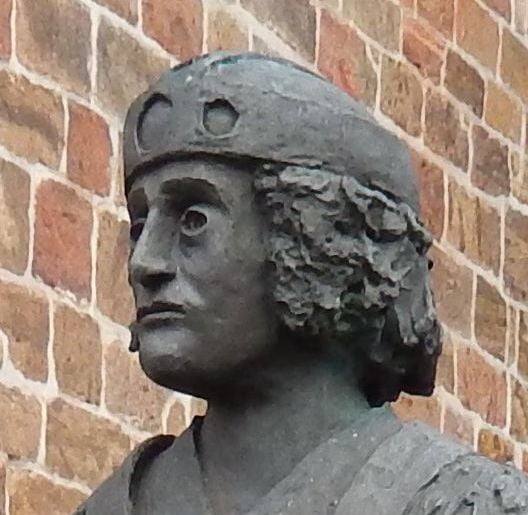
Widukind was a Germanic leader who played a crucial role in the history of the Saxons during the late 8th century. Widukind was a Saxon nobleman who led his people in a long-standing resistance against the Frankish king Charlemagne during the Saxon Wars which took place from 772 to 804.
Widukind belonged to the noble family of the Westphalian branch of the Saxons. His father was Warnechin, a nobleman from the Engrian tribe, and his mother was Geva of Westphalia, the daughter of a Westphalian nobleman. Little is known about Widukind's early life, but he emerged as a strong and charismatic leader, ultimately becoming the rallying point for the Saxon resistance against Frankish expansion.
The Saxon Wars were a series of campaigns initiated by Charlemagne in an attempt to subjugate the Saxons and convert them to Christianity. The Saxons, a pagan Germanic people, fiercely resisted Frankish rule and religious conversion. Widukind led the Saxons in a series of revolts against the Franks, using the advantage of the Saxons' deep knowledge of the local terrain.
Widukind's resistance began in earnest after Charlemagne's infamous massacre of 4,500 Saxon prisoners at Verden in 782, an event known as the Massacre of Verden. In response, Widukind organized and led multiple uprisings against the Franks. He was able to form alliances with other Germanic tribes, such as the Danes and the Frisians, to bolster his forces and fight against Charlemagne's expansion.
However, after years of conflict, and facing mounting pressure from the Franks and realizing the futility of further resistance, Widukind ultimately chose to submit to Charlemagne in 785 AD.
Widukind's conversion to Christianity marked a turning point in the Saxon Wars. He was baptized in the presence of Charlemagne, with the Frankish king acting as his godfather. Following his conversion, Widukind abandoned his leadership role in the resistance and retired from active conflict. He later married Geva, a daughter of a Frankish count, and settled down to a peaceful life.