
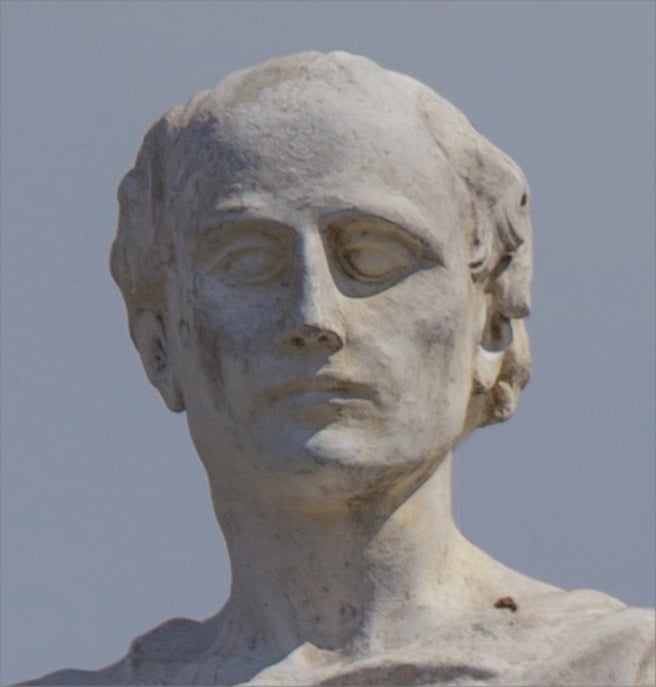
Alcuin was an English scholar, clergyman, poet, and teacher. He played a prominent role in the Carolingian Renaissance, a period of cultural and intellectual revival in Europe during the reign of Charlemagne, the first Holy Roman Emperor.
Born in or around 735 in York, England, Alcuin was educated at the cathedral school and later became a deacon and a master at the school, where he was responsible for educating future scholars, churchmen, and political leaders.
In 781, Alcuin met Charlemagne, the King of the Franks, who was on his way to Rome. Impressed by Alcuin's knowledge and skills, Charlemagne invited him to join his court at Aachen. Alcuin accepted the invitation and became Charlemagne's chief advisor on educational matters. In this capacity, he was responsible for establishing a network of schools and libraries across the Frankish Empire and played a key role in the dissemination of knowledge throughout Europe.
Alcuin's scholarly work covered a wide range of subjects, including theology, biblical exegesis, grammar, rhetoric, poetry, and mathematics. He was also an accomplished Latin poet and wrote numerous poems, many of which were dedicated to his friends and fellow scholars. His contributions to the development of the Latin script, known as Carolingian minuscule, helped make Latin more legible and easier to write, facilitating the spread of learning and literacy throughout Europe.
Alcuin took part in the debates over the Adoptionist heresy, which held that Jesus was not the Son of God by nature but was adopted as such. Alcuin argued against this heresy and defended the orthodox Christian belief in the divinity of Christ.
Alcuin also played an important role in the development of liturgy and the organization of the Frankish church. He was instrumental in reforming the liturgy by revising the texts used in worship and by promoting the use of the Roman rite throughout the Frankish Empire.
In 796, Alcuin retired from his duties at Charlemagne's court and returned to England. He was then appointed the abbot of the monastery of St. Martin at Tours, where he continued his scholarly work until his death in 804.