
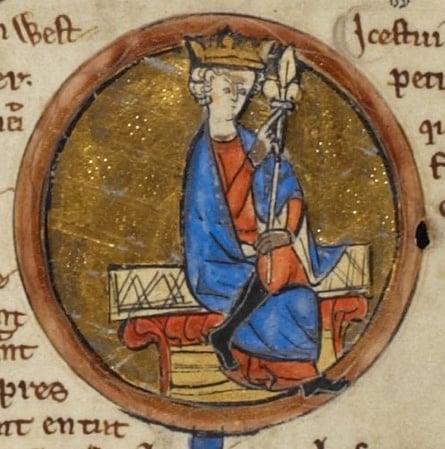
Ecgberht was a significant historical figure in early Anglo-Saxon England. He reigned as the King of Wessex from 802 to 839 AD and is remembered for his important role in uniting the various Anglo-Saxon kingdoms and laying the groundwork for the formation of the Kingdom of England.
Egbert was born in the mid-8th century into the House of Wessex, a prominent Anglo-Saxon dynasty with roots going back to Cerdic, the legendary founder of Wessex. Little is known about Egbert's early life, but it is believed that he spent some time in exile on the European mainland, specifically at the court of Charlemagne.
In 802, King Beorhtric of Wessex died, and Egbert ascended to the throne. This was the beginning of his 37-year reign as the King of Wessex. Egbert's reign was marked by a series of military campaigns aimed at expanding the territories under his control. He first turned his attention to the neighboring kingdoms of Kent, Surrey, Sussex, and Essex. In 825, he defeated the Mercians under King Beornwulf at the Battle of Ellandun, securing control over these southeastern territories. He conquered the kingdoms of Cornwall and Devon, effectively extending Wessex's territories to the English Channel.
During his reign, Egbert also sought to exert control over the other Anglo-Saxon kingdoms, particularly Mercia and Northumbria. While he was not able to directly rule these regions, he was successful in securing their submission and recognition of his overlordship. This enabled him to establish a form of hegemony over much of England.
King Egbert's reign was a pivotal moment in the history of Anglo-Saxon England and set the stage for the eventual emergence of the Kingdom of England, which would be fully realized under his grandson, King Alfred the Great.