
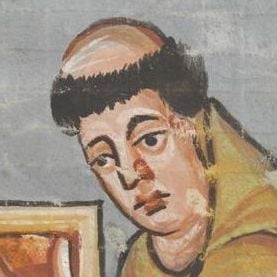
Hrabanus Maurus was an important scholar, theologian, and writer during the Carolingian Renaissance in the early medieval period. Born in 780 in Mainz, he was an influential figure in the intellectual and religious life of his time.
He began his education at a young age, attending the renowned Benedictine Abbey of Fulda and studied the liberal arts, including grammar, rhetoric, dialectic, arithmetic, geometry, music, and astronomy, and became well-versed in Latin, Greek, and Hebrew.
After completing his education, Maurus joined the monastic community at Fulda and was ordained as a deacon. In 803, he was sent to the Abbey of St. Martin in Tours, where he studied under Alcuin for two years. Upon returning to Fulda, Hrabanus was appointed head of the monastery's school, making it a center of learning in the Carolingian Empire.
Maurus's writings covered a wide range of subjects, including theology, biblical exegesis, liturgy, poetry, and natural history. His most notabl work is On the Nature of Things, a 20-volume encyclopedia is a compendium of knowledge about the natural world, drawing on the works of earlier scholars, such as Isidore of Seville and Bede. It topics like cosmology, meteorology, geography, zoology, botany, and mineralogy, providing a comprehensive view of the world as understood in the early Middle Ages.
He also authored numerous commentaries on the books of the Bible, including the Pentateuch, the Psalms, and the Gospels. These works reflect his extensive knowledge of Hebrew, Greek, and Latin, as well as his deep understanding of Christian theology and exegesis.
He died at Winkel on the Rhine in 856.