
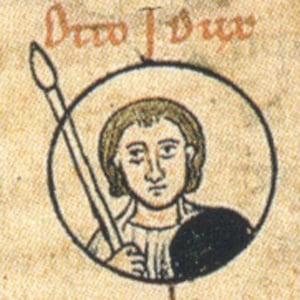
Otto I., Duke of Saxony, was a key figure in the medieval history of Germany. Born around 851 AD, he was a member of the Liudolfing dynasty, which would later produce several Holy Roman Emperors. Otto became the Duke of Saxony in 880, following the death of his father, Liudolf, who was the founder of the dynasty.
During his time as the Duke of Saxony, Otto played a crucial role in consolidating the power and influence of the Saxon people, who were a group of West Germanic tribes that had settled in the region known as Saxony, which is now part of modern-day Germany. Otto's reign was characterized by his ability to maintain relative peace and stability in the region, despite the turbulent political climate of the time.
One of the main threats faced by Otto and his people were the Viking invasions that plagued much of Europe during the 9th and 10th centuries. Otto was successful in defending Saxony against Viking raids, which in turn helped to strengthen his position as a leader within the Saxon territories.
Otto also focused on fostering alliances with other regional powers, most notably the Carolingian Empire, which ruled over a vast territory including modern-day France, Germany, and Italy. Otto's marriage to Hedwiga, a relative of the Carolingian ruler Charles the Fat, further solidified the relationship between the two ruling families.
In addition to his military and political accomplishments, Otto was also a patron of the church and supported the establishment of numerous monasteries and churches throughout his realm, which helped to spread Christianity and strengthen its influence among the Saxons.
Otto's death in 912 AD marked the end of an era for the Liudolfing dynasty. His son, Henry the Fowler, succeeded him as the Duke of Saxony and would go on to become the first Saxon king of East Francia in 919 AD. This marked the beginning of the Ottonian dynasty, which would continue to rule over a vast empire until the early 11th century.