
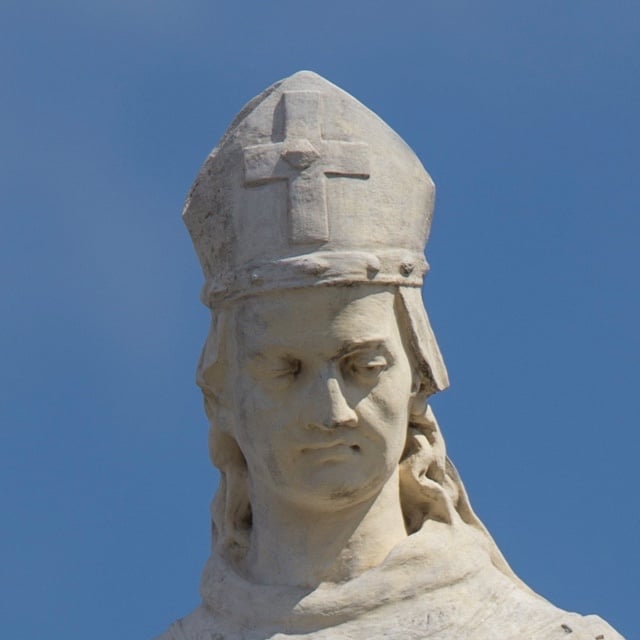
Bernward der Heilige was a German bishop, saint, and patron of the arts during the 10th and early 11th centuries. He served as the Bishop of Hildesheim from 993 to 1022 and was known for his religious, artistic, and educational contributions to the region.
Born around 960 into a noble Saxon family, Bernward was connected to the Ottonian dynasty through his mother, who was a niece of Empress Adelheid the wife of Emperor Otto I. This connection allowed him to receive a high-quality education and access to influential political and religious circles.
Bernward received his early education at the cathedral school in Hildesheim before studying at the court of Emperor Otto II. in Magdeburg, where he was influenced by the teachings of the great scholar and Archbishop, Thietmar.
In 993, Bernward was appointed as the Bishop of Hildesheim by Emperor Otto III. He founded a cathedral school in Hildesheim, which became a leading center of learning in the region. He also worked to reform monastic life and supported the development of new religious institutions, including the construction of the monastery of St. Michael in Hildesheim.
Patron of the Arts:
Bernward is perhaps best known for his role as a patron of the arts. Some of his most famous artistic commissions include the bronze doors of Hildesheim Cathedral, which depict scenes from the Old and New Testaments; the Bernward Column, a monumental bronze column that narrates the life of Christ; and the creation of the ornate Cross of Bernward, a gilded processional cross decorated with gems and enamel work.
Bernward died in 1022. His death marked the end of an era of cultural and artistic achievements for Hildesheim and the wider Ottonian realm. In recognition of his piety, religious dedication, and contributions to the church, he was canonized as a saint in 1193 by Pope Celestine III.