
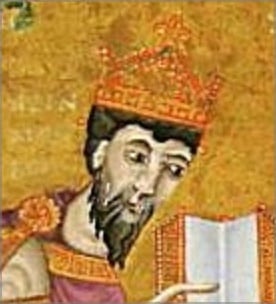
Henry III., also known as Henry the Black was the Holy Roman Emperor from 1046 until his death in 1056. He was a member of the Salian dynasty and ruled as the King of Germany from 1039, succeeding his father, Conrad II. Henry III's reign was marked by his efforts to consolidate and strengthen the Holy Roman Empire, his involvement in church reform, and his territorial expansion.
Henry III was in 1017, to Emperor Conrad II and Empress Gisela of Swabia. In 1027, he was appointed as the Duke of Bavaria, a position he held until 1042.
Upon his father's death in 1039, Henry became the King of Germany. He was crowned as the Holy Roman Emperor in 1046 by Pope Clement II., following a successful military campaign in Italy where he intervened in a papal schism and deposed three rival popes. His involvement in this matter demonstrated his commitment to church reform and his authority over the papacy.
As the Holy Roman Emperor, Henry III pursued a policy of strengthening the empire's central authority and consolidating its territories. He suppressed rebellions and conflicts among the nobility, as well as expanded the empire's borders. His military campaigns included successful conquests in Bohemia, Hungary, and Poland, which brought these regions under imperial control.
Henry III was a strong advocate of church reform and sought to eliminate corruption within the church hierarchy. He played an influential role in the selection of popes during his reign, appointing four popes, including Pope Leo IX, who initiated the major reform movement of the 11th century.
Henry III died in 1056, at the age of 38. His early death left the empire in the hands of his widow, Empress Agnes of Poitou, who acted as regent for their young son, Henry IV. The period following Henry III's death was marked by political instability and conflict, as various factions sought to assert their influence over the young king and the direction of the empire.