
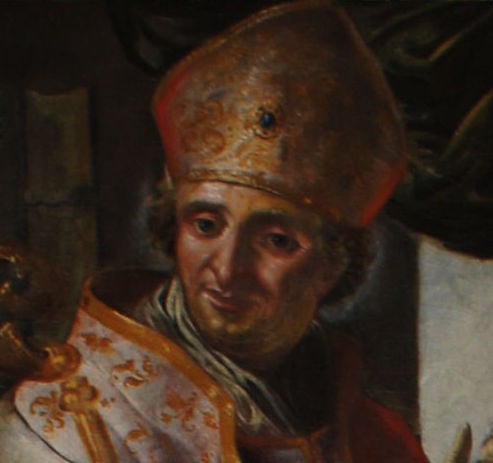
Otto von Freising was a German bishop, historian, and theologian who lived during the 12th century. He served as the Bishop of Freising from 1138 until his death in 1158 and was a key intellectual figure of his time.
Otto was born around 1114 in Austria, a member of the powerful House of Babenberg. He was a half-brother of the future Holy Roman Emperor Conrad III and a nephew of Emperor Henry V. As a young man, Otto studied in Paris, then afterward, entered the Cistercian Order in 1133, joining the Morimond Abbey in France before transferring to the Abbey of St. Blasien in the Black Forest, Germany.
In 1138, Otto was appointed as the Bishop of Freising, a position he held until his death in 1158. As bishop, he is best known for his historical writings, which are marked by their intellectual depth, narrative style, and engagement with contemporary theological and philosophical ideas.
His work, the Chronicle or History of the Two Cities), completed around 1146, is a universal history that traces the course of human events from the creation of the world to the his time as Bishop. Otto's narrative is structured around the concept of the two cities, drawing on the ideas of St. Augustine. He contrasts the earthly city, characterized by strife and material pursuits, with the heavenly city, representing spiritual and eternal values.
The book Deeds of Emperor Frederick, written between 1152 and 1158, is a biography of Emperor Frederick I Barbarossa, Otto's nephew. It provides a detailed account of Frederick's early reign and offers insights into the political and military affairs of the Holy Roman Empire during the 12th century. The work is unfinished, as Otto died before he could complete it.
Otto von Freising died in 1158. His legacy as an intellectual and historian endures through his historical writings, which are considered important sources for the study of medieval European history, but also showcase Otto's engagement with contemporary theological and philosophical ideas.