
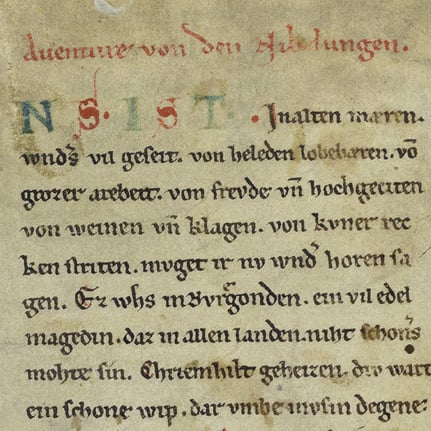
The Poet of the Nibelungenlied refers to the unknown author who composed the Nibelungenlied, an epic poem in Middle High German. The Nibelungenlied is an epic poem consisting of approximately 2,400 stanzas and is divided into 39 chapters. It is written in Middle High German and tells the story of the hero Siegfried, his marriage to the Burgundian princess Kriemhild, his betrayal and murder by his brothers-in-law, and Kriemhild's subsequent quest for revenge. The story draws on Germanic and Norse legends and oral traditions, as well as historical events from the 5th and 6th centuries, such as the fall of the Burgundian kingdom at the hands of the Huns.
The Nibelungenlied is believed to have been composed around 1200 AD. It is likely that the poem was written by a single author, although some scholars have suggested that it may be the result of multiple authors. The identity of the poet remains unknown, but the poem's language and style suggest that the author was likely from the region of the Danube, possibly from the area around Passau or Regensburg.
The Nibelungenlied was composed during a period of significant cultural and intellectual activity in the Holy Roman Empire. The 12th and 13th centuries saw the rise of courtly culture, chivalric ideals, and a flourishing of vernacular literature in the German-speaking regions of the empire. The poem reflects these developments and draws on a rich tradition of oral storytelling and epic poetry.
The Nibelungenlied's structure and content demonstrate the influence of various literary traditions, such as the heroic epic, courtly romance, and minstrel tales. The poem combines elements of Germanic mythology, chivalric ideals, and Christian morality, creating a complex and multi-layered narrative that explores themes of love, loyalty, betrayal, and revenge.
The poem has been adapted, retold, and reinterpreted in various forms throughout the centuries, including Richard Wagner's famous four-opera cycle, Der Ring des Nibelungen.