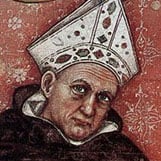
Albertus Magnus was a German Dominican friar, philosopher, theologian, and bishop who made important contributions to the fields of natural science, theology, and philosophy.
Albertus was born around 1200 in Lauingen, Swabia, in present-day Germany.
He began his education at the University of Padua in Italy, where he was introduced to the works of Aristotle and other ancient philosophers. In the early 1220s, he joined the Dominican Order, a religious order known for its commitment to intellectual pursuits and theological scholarship.
As a Dominican friar, Albertus studied and taught at various monastic schools and universities throughout Europe, including Köln, Paris, and Bologna. This perspective led him to study and comment on the works of Aristotle extensively, as well as the writings of Muslim and Jewish scholars.
Among his many texts, Albertus produced commentaries on nearly all of Aristotle's known works, such as De animalibus, a comprehensive study of the animal kingdom that draws on both classical sources and Albertus' own observations.
In addition to his scholarly pursuits, Albertus also held various administrative positions within the Church. In 1260, he was appointed as the Bishop of Regensburg, where he served for a few years before resigning to return to teaching and writing.
Albertus died in 1280 in Cologne, and his contributions to philosophy, theology, and the natural sciences continued to be influential long after his death. In 1931, Pope Pius XI declared Albertus Magnus a Doctor of the Church, a title that recognizes his contributions to Christian thought and doctrine. He was also canonized as a saint in the Roman Catholic Church, and his feast day is celebrated on November 15.