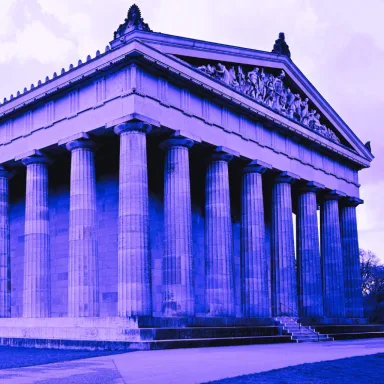

When King Ludwig I began planning Walhalla, he first imagined a more modest facade, perhaps with seventeenth- or eighteenth-century style reliefs or simple bronze lettering. In 1817, Leo von Klenze proposed a bolder solution: both temple tympanums would be filled with free-standing, three-dimensional sculpture.
The idea drew on ancient Greek temple design and on the Aegina marbles, excavated in 1811 and soon acquired by Ludwig for his collection. For neoclassical artists, free-standing figures offered better proportions than relief, avoided the visual compromises of shallow carving, and created a stronger effect from below.
Martin von Wagner produced early designs in 1818. Ludwig also tried to involve Christian Daniel Rauch, the celebrated Prussian sculptor, but Rauch remained cautious about working with the Bavarian king and supplied only a small model for the south tympanum in 1831.
The main work went to Ludwig Schwanthaler and his Munich workshop. Supported by a royal grant, Schwanthaler studied in Rome and prepared the plaster models. The fifteen marble figures of the south tympanum, some up to three meters high, were carved and installed by October 1838. The north tympanum followed and was completed in June 1842.
The south tympanum, above the main entrance, celebrates the German Confederation after the Wars of Liberation against Napoleon. Germania sits in the center with a lowered sword, while personifications of German states approach her with reclaimed frontier fortresses. The Rhine and Mosel rest in the corners as rivers freed from foreign control.
The north tympanum shows the Battle of the Teutoburg Forest in 9 AD, presenting Arminius, or Hermann, as a historical parallel to the defeat of Napoleon's empire. Germanic warriors charge from the left, urged on by a seer and a bard. On the right, Varus falls on his sword as a Roman soldier sinks into the swamp; at the flank, Thusnelda tends her dying father.