
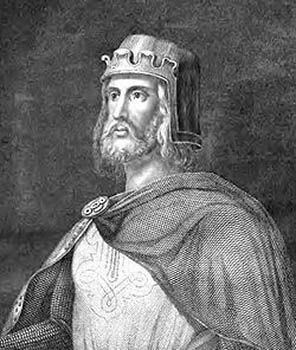
Heinrich I., better known as Henry the Fowler, was the first non-Frankish king of East Francia and founder of the medieval German state.
Born into the Liudolfing line of Saxon dukes, Henry obtained the nickname The Fowler due to his love of hunting birds. Legend has it that he was fixing his birding nets when messengers arrived to inform him that he was to be king.
Henry was elected and crowned king in 919, following a recommendation by his predecessor Conrad I of Germany on his deathbed in 918. Despite facing internal revolts and external Magyar raids, Henry successfully consolidated his rule by defeating rebellious dukes and acquiring Lotharingia as a vassal in 925.
Unlike his Carolingian predecessors, Henry did not seek to create a centralized monarchy. Instead, he ruled through federated autonomous stem duchies and built an extensive system of fortifications and mobile heavy cavalry to neutralize the Magyar threat.
Henry greatly expanded German hegemony in Europe by defeating the Slavs at the Battle of Lenzen in 929, invading the Duchy of Bohemia and compelling the submission of Duke Wenceslaus I in the same year, and conquering Danish realms in Schleswig in 934.
His hegemonic status was acknowledged by the kings Rudolph of West Francia and Rudolph II of Upper Burgundy, who both accepted a subordinate place as allies in 935. Henry planned an expedition to Rome to be crowned emperor by the pope, but his death prevented the plan from being fulfilled.
Henry left a much stronger kingdom to his successor, Otto the First, and was buried at Quedlinburg Abbey, which had been established by his wife Matilda in his honour.