
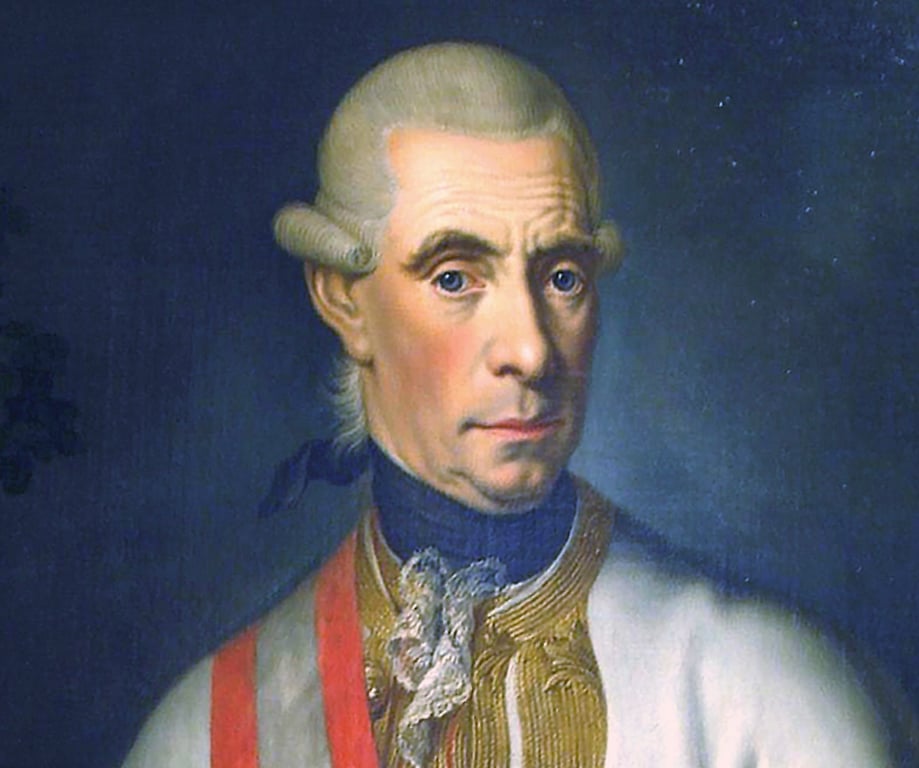
Ernst Gideon Freiherr von Laudon was a well-known military commander and field marshal in the Austrian Empire during the 18th century. He was born in 1717, in the province of Livonia in present-day Estonia, which was then part of the Swedish Empire.
Laudon was born into a noble family of German origin and received a strict Lutheran upbringing. His early life was marked by poverty and insecurity, as his family's fortunes declined and Livonia became a battleground for various European powers.
At the age of 15, Laudon joined the Swedish army and fought in the Russo-Swedish War of 1741. He then served in the Saxon and Prussian armies before being recruited by Empress Maria Theresa of Austria in 1756, at the outbreak of the Seven Years' War.
Laudon quickly established himself as a brilliant and innovative commander, known for his ability to improvise and adapt to changing circumstances on the battlefield. He was instrumental in several key Austrian victories, including the Battle of Kunersdorf in 1759 and the Siege of Belgrade in 1789.
Laudon's military career spanned over 50 years, during which he fought in numerous conflicts across Europe, including the War of the Austrian Succession, the Seven Years' War, the War of the Bavarian Succession, and the Russo-Turkish War. He was also involved in suppressing the Polish-Lithuanian Commonwealth's Bar Confederation uprising.
In addition to his military exploits, Laudon was also known for his personal eccentricities and rough manner. He was known to be fiercely independent and had a reputation for being difficult to work with, however, his military genius and tactical brilliance earned him the respect and admiration of his peers and superiors alike.
Laudon was made a Count of the Holy Roman Empire in 1765 and was awarded numerous other honours and decorations throughout his career. He died in 1790 on his estate in Moravia, at the age of 73. His legacy as one of Austria's greatest military commanders has endured to this day.