
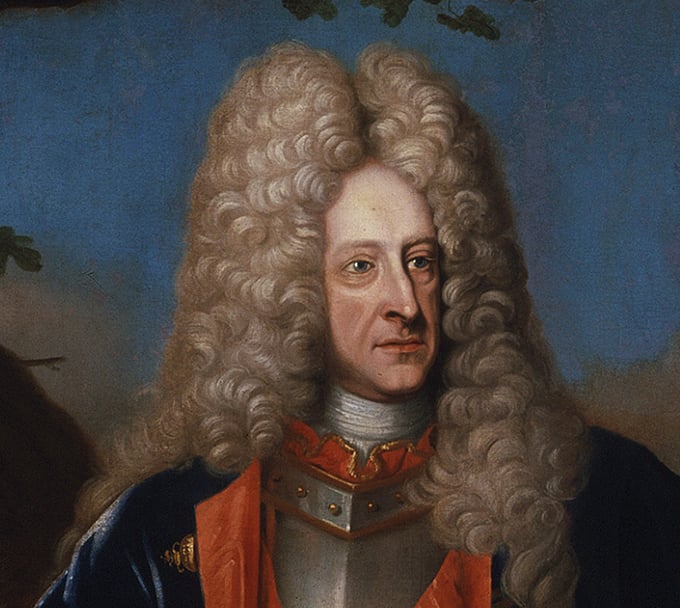
Ludwig Wilhelm I. was the Duke of Württemberg-Bernstadt, a territory located in present-day Germany. He was born on October 27, 1655, in Stuttgart, the capital of the Duchy of Württemberg, to the ruling Duke Eberhard III and his consort, Duchess Anna Katharina.
Ludwig Wilhelm I. was the second son of Eberhard III, and as such, he was not in line to inherit the throne of Württemberg. Therefore, in 1677, he was appointed by Emperor Leopold I as the Duke of Bernstadt, a small principality in Silesia, which was then part of the Holy Roman Empire.
As the Duke of Bernstadt, Ludwig Wilhelm I. was known for his liberal policies, which encouraged economic growth and the arts. He also invested heavily in the development of the town of Bernstadt, which he turned into a cultural center, building a theater, a library, and a music school.
Ludwig Wilhelm I. was a patron of the arts and sciences, and he attracted many intellectuals and artists to Bernstadt. He himself was a gifted musician and composer, and he composed several operas and cantatas. He also supported the work of the famous baroque composer Georg Philipp Telemann, who was the court musician in Bernstadt from 1704 to 1706.
However, Ludwig Wilhelm I.'s rule was not without controversy. He was involved in several conflicts with neighboring territories, including the Electorate of Saxony and the Kingdom of Prussia, over the control of certain territories. These disputes were often settled through diplomatic means, but sometimes they escalated into armed conflicts.
Ludwig Wilhelm I. died on June 17, 1707, in Bernstadt, at the age of 51. He was succeeded as Duke of Bernstadt by his son, Karl Friedrich. Ludwig Wilhelm I.'s legacy as a patron of the arts and culture is still remembered in Bernstadt today, and the town continues to celebrate its rich cultural heritage.