
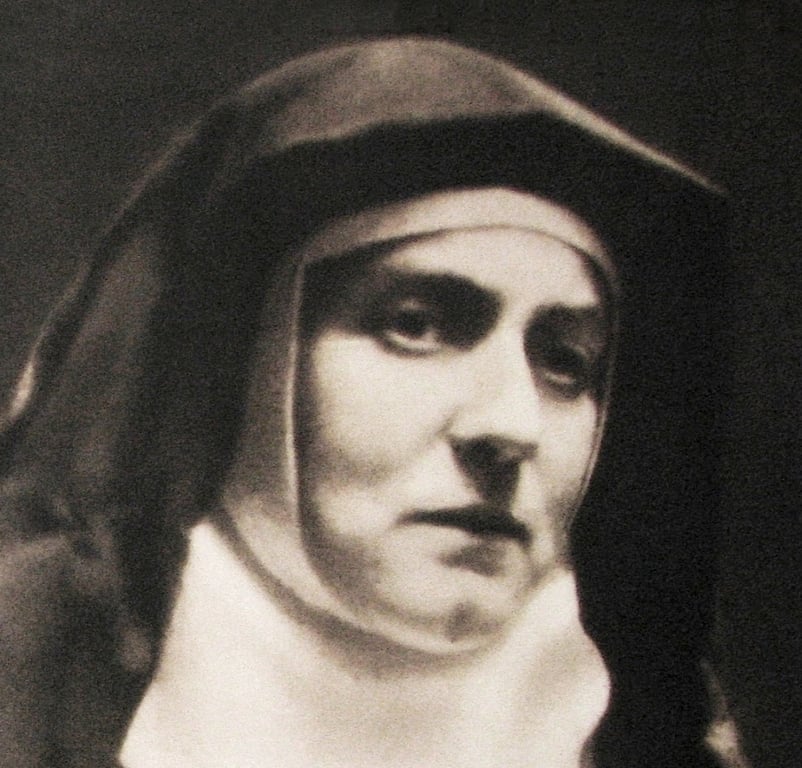
Edith Stein was a German philosopher and nun who is now recognized as a Catholic saint. She was born in Breslau, Germany to a Jewish family, but she later converted to Catholicism.
After completing her studies at the University of Göttingen, where she studied philosophy under the famous philosopher Edmund Husserl, Stein became an assistant professor at the University of Freiburg. She wrote several works on phenomenology, including her doctoral thesis on empathy, and quickly gained a reputation as a leading thinker in the field.
Despite her success, Stein felt unfulfilled and began to explore Catholicism. In 1922, she was baptized and officially became a Catholic. She eventually entered the Discalced Carmelite order and took the name Sister Teresa Benedicta of the Cross.
As the National Socialists' regime rose to power, Stein's Jewish heritage became a liability. In 1933, she was forced to leave her position at the University of Münster due to the government's anti-Semitic policies. She fled to the Netherlands, where she continued her work and eventually became a lecturer at the Catholic University of Nijmegen.
However, the Nazis invaded the Netherlands in 1940, and Stein was once again in danger. Despite attempts to help her flee to Switzerland, she was arrested by the Gestapo in 1942 and taken to the Auschwitz concentration camp. She was killed in the gas chambers along with her sister Rosa, who had also converted to Catholicism.
Edith Stein's life and work have continued to inspire Catholics and non-Catholics alike. She was canonized by Pope John Paul II in 1998 and is now recognized as a patron saint of Europe. Her writings on phenomenology and her spiritual journey continue to be studied and admired by scholars and spiritual seekers around the world.