
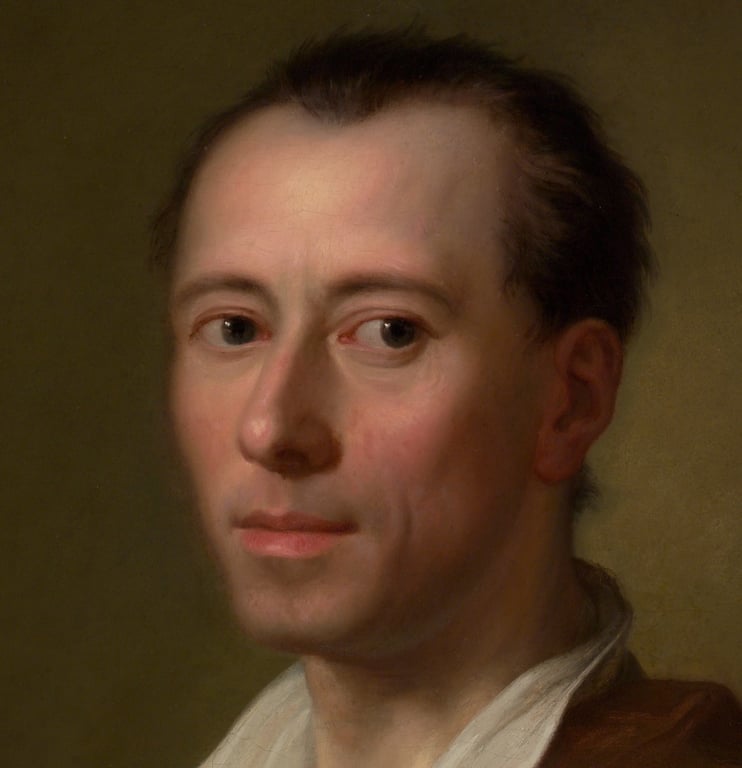
Johann Joachim Winckelmann was a German art historian and archaeologist, who is considered one of the most important figures in the development of neoclassical art.
Born in Stendal, Prussia, in 1717, Winckelmann was the son of a cobbler. He received his education at the Stendal Gymnasium and later studied theology and philosophy at the University of Jena. However, it was his interest in ancient art that would define his career.
In 1755, Winckelmann published his first major work, "Reflections on the Imitation of Greek Works in Painting and Sculpture." In this work, he argued that Greek art was the pinnacle of aesthetic achievement, and that artists should look to the classical world for inspiration. His ideas had a significant impact on the development of neoclassical art, which sought to emulate the ideals of ancient Greece and Rome.
In 1758, Winckelmann was appointed librarian to Cardinal Albani in Rome, where he had access to the city's rich collection of classical art. He devoted himself to the study of ancient art and architecture, and in 1764 he published his most famous work, "History of Ancient Art." This book is considered a landmark in the history of art criticism and is still studied today. In it, Winckelmann traced the evolution of ancient art from its origins in Egypt and Mesopotamia to the classical period in Greece and Rome.
Winckelmann's work strongly influenced the art world, and his ideas about the importance of classical art and its influence on contemporary art were widely accepted. He is also credited with helping to establish the discipline of art history as a distinct field of study.
Sadly, Winckelmann's life was cut short in 1768 when he was murdered in Trieste, Italy, while on his way back to Rome. The motives for his murder are unclear, but some believe it was related to a dispute over the ownership of some ancient artifacts he had acquired.