
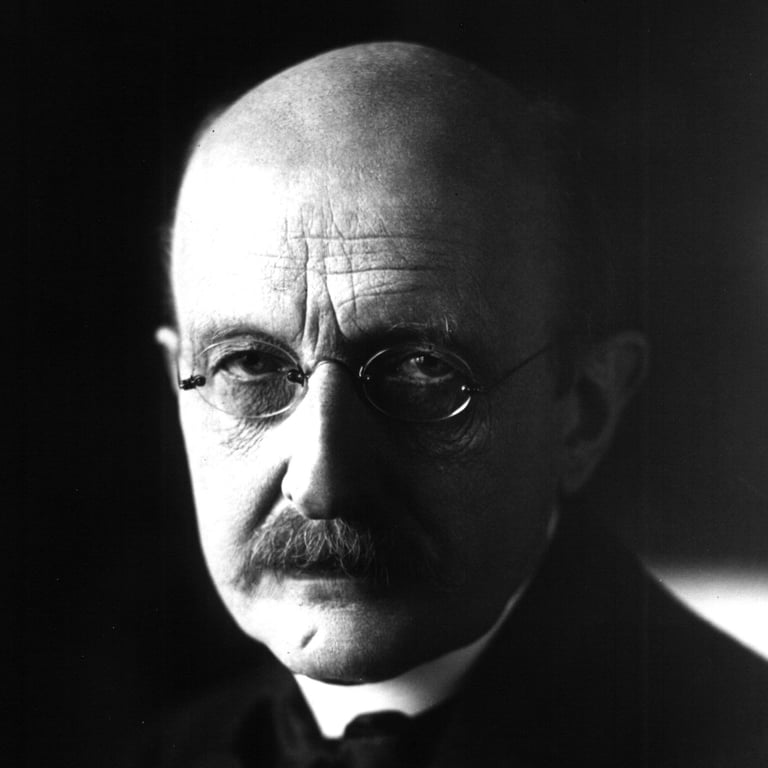
Max Planck, born Karl Ernst Ludwig Marx Planck in 1858, came from an intellectual family with a history in theology and law. Born in Kiel, he was the sixth child in his family, and his early years were marked by the Second Schleswig War. In 1867, his family moved to Munich where he enrolled in the Maximilian gymnasium school. Here, under the guidance of Hermann Müller, he learned about astronomy, mechanics, and the principle of conservation of energy, sparking his interest in physics. Despite his musical talents, Planck chose to study physics.
He began his studies in 1874 at the University of Munich, despite being advised against it by Professor Philipp von Jolly, who believed that almost everything in physics had already been discovered. Planck's only experiments involved studying the diffusion of hydrogen through heated platinum. In 1877, he went to Friedrich Wilhelms University in Berlin to study with physicists Hermann von Helmholtz and Gustav Kirchhoff and mathematician Karl Weierstrass. Despite their differing teaching styles, Planck became close friends with Helmholtz and chose thermodynamics as his field after self-studying Clausius' writings. He passed his qualifying exams in October 1878 and defended his dissertation on the second law of thermodynamics in February 1879.
Planck contributed significantly to theoretical physics. Still, his reputation as a physicist mainly stems from his role as the originator of quantum theory, a concept that revolutionized our understanding of atomic and subatomic processes. In 1948, the Kaiser Wilhelm Society, a German scientific institution that Planck presided over twice, was renamed the Max Planck Society. Today, the society encompasses 83 institutions, representing a broad spectrum of scientific disciplines.