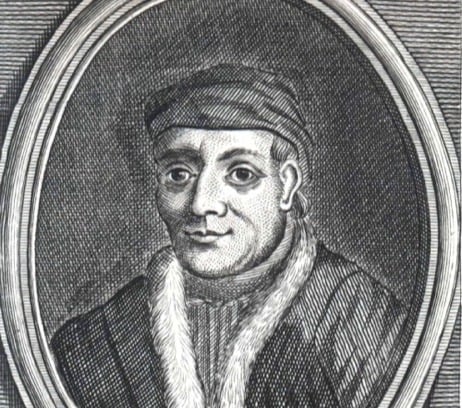
Johannes Müller, also known as Regiomontanus, was a highly regarded mathematician, astronomer, and astrologer during the fifteenth century in Germany. He was born on June 6, 1436, in Königsberg, Bavaria, which is presently known as Cheb, Czech Republic.
Müller received his initial education from his wealthy merchant father, followed by attending the University of Leipzig and the University of Vienna. He studied mathematics, astronomy, and astrology during his time at both institutions. His talents in mathematics and astronomy were quickly noticed by the famous astronomer and mathematician Georg von Peuerbach, who invited him to study under his guidance.
Müller and Peuerbach collaborated on multiple projects, including the creation of new astronomical tables, which were published in 1459 under the title "Tabulae directionum et profectionum." After Peuerbach's death in 1461, Müller continued the work and completed the tables, which later became known as the "Ephemerides" or "Regiomontanus Tables."
Müller's mathematical and astronomical contributions were substantial. He made numerous enhancements to existing astronomical tables, which were utilized for forecasting the positions of planets and stars. He developed and built various astronomical instruments, including a portable equatorial sundial, a lunar volvelle, and a quadrant.
Müller was an accomplished writer, and his publications include "De triangulis omnimodis," a treatise on trigonometry, and "De libris revolutionum Copernici narratio prima," an account of the Copernican system. He was also interested in astrology, and his book "De judiciis astrologicis" explored the practical applications of astrology.
In 1467, Müller moved to Nuremberg, where he established an observatory and continued his work in astronomy and mathematics. He was appointed as the court mathematician to Hungarian King Matthias Corvinus in 1471, but he returned to Nuremberg in 1475. He passed away on July 6, 1476, at the age of 40.
Müller's contributions to astronomy and mathematics were noteworthy, and his work influenced many of the great astronomers and mathematicians of the sixteenth and seventeenth centuries, including Tycho Brahe, Johannes Kepler, and Galileo Galilei.