
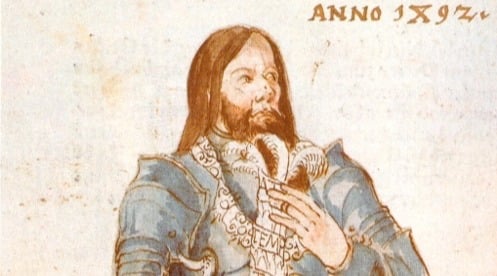
Eberhard V, also known as Eberhard im Bart, was an important figure in the history of the Duchy of Württemberg in southwestern Germany. He was born on February in 1445 in Tübingen, a town that was part of the Duchy of Württemberg. Eberhard was the second son of Ludwig I, the Count of Württemberg and his wife Mechthild von der Pfalz. Although he was not expected to inherit the title of Count, he became the heir after his older brother Ulrich died in 1478.
As Count of Württemberg, Eberhard was known for his political and military skills. He expanded his territory through alliances and conquests, and introduced important reforms that modernized the region. One of his most important accomplishments was the establishment of the University of Tübingen in 1477, one of the first universities in Germany. This institution played a crucial role in the development of humanism and the Protestant Reformation.
Eberhard's distinctive beard, which earned him the nickname "im Bart," was said to have been grown to hide scars he received in battle. Despite his impressive accomplishments, Eberhard's involvement in the German Peasants' War is somewhat controversial. Initially, he supported the peasants' demands for social and economic reform, but later he turned against them when they became violent. His forces defeated the rebels in a series of battles, and Eberhard emerged as a hero to the ruling classes.
Eberhard died on February 24, 1496, at the age of 51. He was succeeded by his son Ulrich, who continued his father's policies and expanded the power and influence of the Württemberg dynasty.