
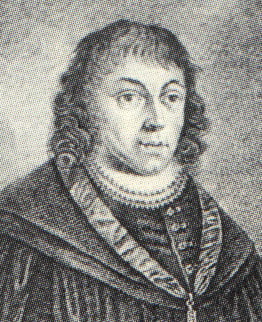
Johann von Dalberg was an important figure in the late 15th century who was born into the prestigious family of Dalberg. He was the second son of eleven children and studied in Erfurt and Pavia, becoming a leading patron of early German humanism. Johann actively promoted humanist efforts at the electoral court, making Heidelberg an important center of early German humanism. He also compiled an extensive library, including works in Greek and Hebrew, which he made available to friends.
At the age of 27, Johann was appointed Chancellor of the Electoral Palatinate and later became the Bishop of Worms in 1482. He was the first member of his family to rise to the rank of imperial prince. Johann strongly supported the reforms of Abbess Margaretha von Venningen at Rosenthal Abbey and commissioned the priest Jakob Stoll of Alsheim to hold a diocesan visitation.
Johann was a leading figure in the circle of humanists surrounding him and actively exchanged ideas with other renowned scholars of his time, such as Conrad Celtis, Johannes Reuchlin, and Adolph Occo. With Johann's encouragement and under his patronage, Celtis founded the Sodalitas litteraria Rhenana in 1491, which had its headquarters in Heidelberg.
Johann von Dalberg died unexpectedly in 1503 and was buried in Worms Cathedral, but his funeral celebrations were overshadowed by the continuing dispute between the city and the bishop.