
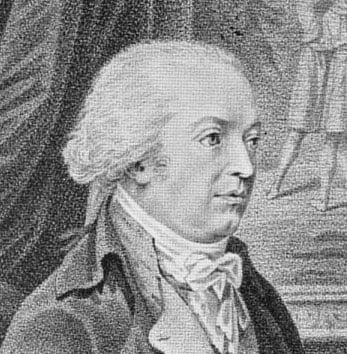
Johannes von Müller was a well-known Swiss historian born in Schaffhausen, Switzerland on January 3, 1752, and died on May 29, 1809, in Kassel, Westphalia, Germany. He was recognized as the most important Swiss historian of the 18th century.
Müller's life was marked by a conflict between his roles as a scholar and as a diplomat and political journalist. He served as a political journalist and diplomat at the court of the archbishop of Mainz from 1786 to 1792 and in the imperial chancery in Vienna from 1793 to 1798. In his later years, he worked as the director of education for the kingdom of Westphalia under Napoleon's service.
Müller's most notable work was Geschichten Schweizerischer Eidgenossenschaft, which combined his comprehensive knowledge of chronicle sources, particularly Aegidius Tschudi, with a concise elegance that earned him the moniker "Swiss Tacitus." His idealistic and patriotic portrayal of the ancient Swiss constitution strongly influenced the 19th-century European perspective of Switzerland and was the basis for Friedrich Schiller's Wilhelm Tell.
In addition to his History of the Swiss Confederation, Müller's political journalism works Fürstenbund and Reisen der Päpste established him as a significant theorist of the European balance of power.
Müller's attempt at a universal history, the 24 Bücher allgemeiner Geschichten, reflects the historical outlook of the Enlightenment while also pointing forward to Leopold von Ranke in its religious conception.
Müller endeavored to unite the spiritual heritage of Rome with the German roots of his civilization. His exceptional personality, which was influenced by the classics and Christianity, was embraced by German classicism, including J.G. von Herder, Goethe, and Schiller.