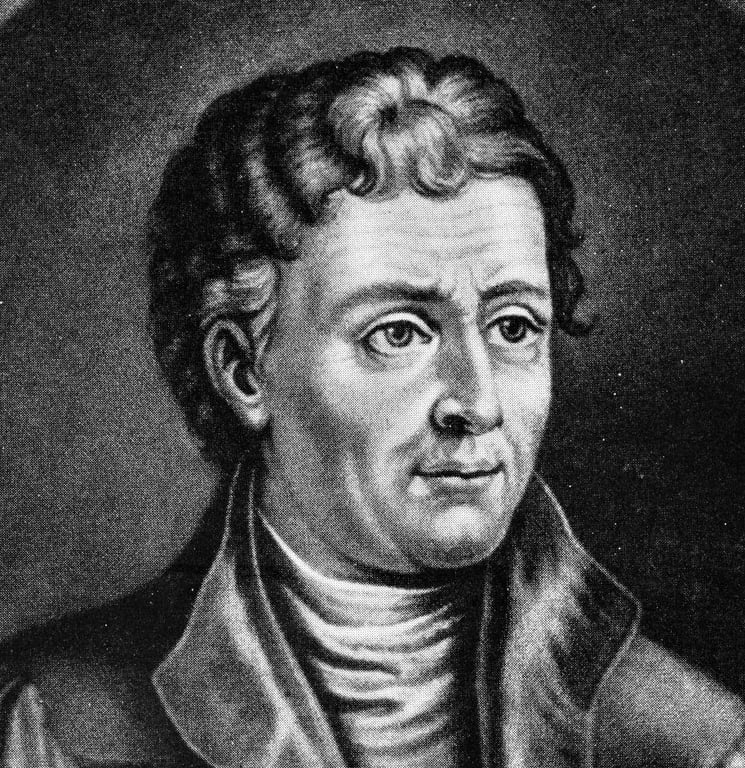
Johannes Reuchlin was born on February 22, 1455, in Pforzheim, Württemberg. From an early age, he showed an interest in language and literature, and he went on to study Greek at various universities. He published a Latin lexicon in 1475-76 before switching to law, earning his degree in 1481. Reuchlin held various court and judicial posts in Württemberg and Stuttgart from the 1480s until 1512.
During the 1490s, Reuchlin became interested in Hebrew, and in 1506, he published "De Rudimentis Hebraicis," a grammar and lexicon that promoted the scientific study of Hebrew and the Old Testament in its original language. However, his defense of Hebrew literature caused controversy when the Dominicans of Cologne, led by Johannes Pfefferkorn, convinced Emperor Maximilian I to order the destruction of Hebrew books as hostile to Christianity in 1509.
Reuchlin stood firm in his defense of the study and preservation of Hebrew literature, which led to Dominican inquisitor Jacob Hochstraten initiating procedures against him in 1513. Reuchlin appealed to Pope Leo X, and the entire European liberal and humanist community aligned themselves on his side against the Dominicans. In 1516, a papal commission acquitted Reuchlin of heresy. The controversy led to the publication of the "Epistolae obscurorum virorum," a satirical pamphlet by young humanists that ridiculed late scholasticism as represented by the Dominicans.
Despite the benefits of his stand in the Hebrew-literature controversy to the Protestant cause, Reuchlin repudiated his nephew, Philip Melanchthon, and Martin Luther in their separation from Roman Catholicism. He remained a respected scholar, second only to Desiderius Erasmus among German humanists and the most important German teacher of Greek and Hebrew in his day. Although his defense of Hebrew literature may have been overshadowed by the Reformation, his work helped awaken liberal intellectual forces in the years preceding it.