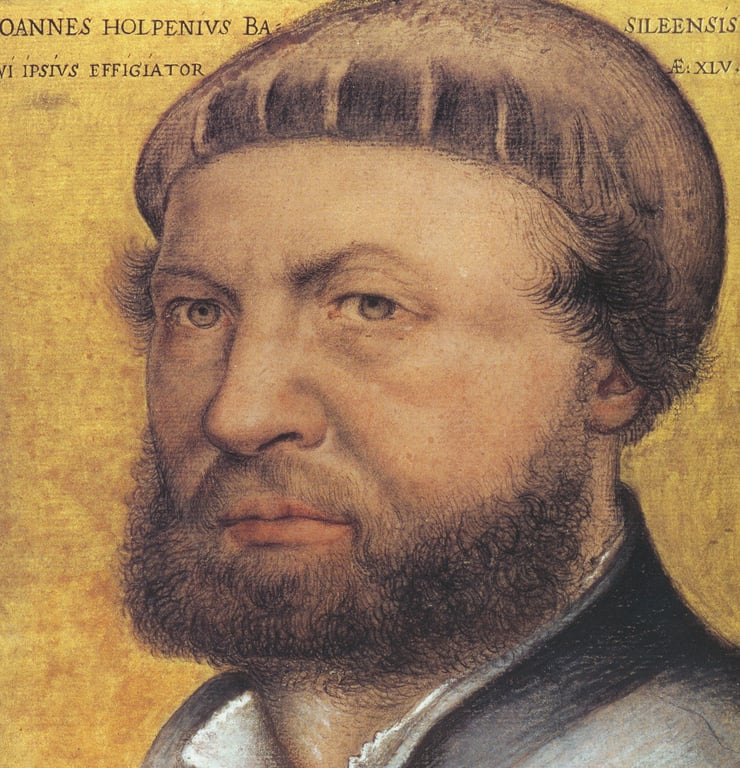
Hans Holbein der Jüngere was a German artist and one of the greatest portraitists of the Renaissance. He was born in Augsburg, Bavaria, to Hans Holbein the Elder, also a painter, and his wife Barbara. The family moved to Basel, Switzerland, in 1515, where Holbein would spend most of his career.
In Basel, Holbein quickly established himself as a talented artist, creating portraits and religious works for local patrons. His early works were heavily influenced by the Northern Renaissance tradition, but he also incorporated elements of Italian Renaissance art into his style.
In 1526, Holbein traveled to England at the invitation of Sir Thomas More, the Lord Chancellor. He quickly found favor with the English court, and his portraits of King Henry VIII and his courtiers became some of his most famous works. He also worked on a number of religious commissions for English churches, including a series of murals for the walls of the Privy Chamber at Whitehall Palace.
Despite his success in England, Holbein faced numerous challenges throughout his career. He struggled to gain recognition as a painter of historical and religious subjects, and his works were often criticized for their realism and lack of idealization. He also faced financial difficulties and struggled to support his family.
Holbein died in London in 1543, possibly of the plague, at the age of 45. His legacy as a portraitist, however, continued to grow in the centuries that followed, and he is now regarded as one of the most important artists of the Renaissance.