
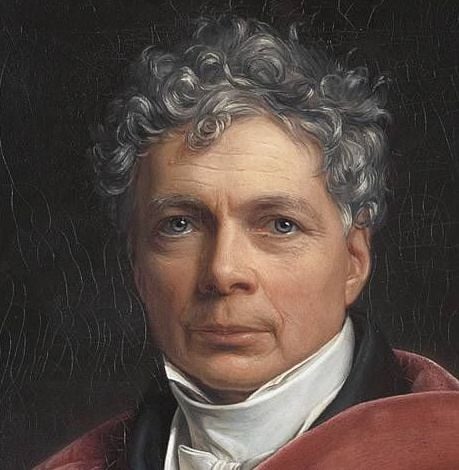
Friedrich Wilhelm Joseph Schelling was a German philosopher who played an important role in the development of German idealism. He was born on January 27, 1775, in Leonberg, a small town in the Duchy of Württemberg, which is now part of Germany.
Schelling studied theology at the University of Tübingen, where he also became interested in philosophy, particularly the works of Immanuel Kant. In 1795, Schelling published his first major work, "On the Possibility of a Form of Philosophy in General," which aimed to establish the legitimacy of philosophy as a discipline in its own right, separate from theology.
In 1798, Schelling published another important work, "Ideas for a Philosophy of Nature," in which he developed a natural philosophy that sought to unify the sciences with a single principle or "Ur-substance." This work marked a major departure from Kant's critical philosophy and influenced later thinkers, including the German biologist and philosopher Ernst Haeckel.
Schelling's philosophy underwent a significant change in the early 1800s, when he became interested in mysticism and the occult. He began to see the world as a manifestation of a divine or spiritual principle, which he called the "Absolute." This idea was developed further in his later works, such as "System of Transcendental Idealism" and "Philosophical Investigations into the Essence of Human Freedom".
Schelling was appointed to a professorship in philosophy at the University of Jena in 1801, where he worked alongside other prominent German philosophers, including Johann Gottlieb Fichte and Georg Wilhelm Friedrich Hegel. However, Schelling's relationship with Hegel became strained, and the two eventually fell out. Schelling left Jena in 1803 and went on to teach at various universities throughout Germany.
Despite his early influence on German idealism, Schelling's later work was often criticized for its mystical and obscure nature. Nevertheless, he remains an important figure in the history of philosophy, and his ideas continue to influence contemporary thinkers in a range of fields, including philosophy, theology, and ecology.