
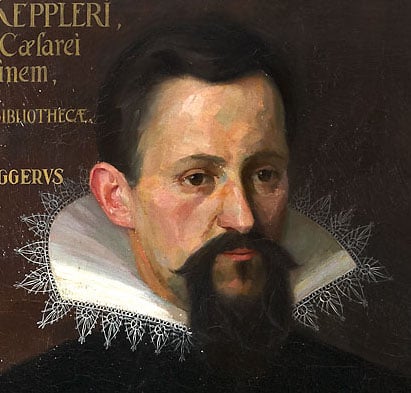
Johannes Kepler was a German mathematician, astronomer, and astrologer who made important contributions to the development of modern astronomy. Kepler was born on December 27, 1571, in Weil der Stadt, in the Holy Roman Empire.
Kepler received his early education in nearby Leonberg and then enrolled at the University of Tübingen in 1589, where he studied theology, philosophy, and mathematics. During his time at the university, Kepler became interested in astronomy after attending a lecture by the astronomer Michael Maestlin. Maestlin recognized Kepler's mathematical talent and became his mentor, teaching him about the Copernican model of the solar system, which placed the sun at the center of the universe.
After completing his studies at Tübingen, Kepler became a mathematics teacher and worked on improving the accuracy of astronomical observations. In 1600, he became the assistant to the astronomer Tycho Brahe, who had amassed a vast amount of observational data on the movements of the planets. After Brahe's death in 1601, Kepler inherited Brahe's astronomical data, which he used to develop his laws of planetary motion.
Kepler's laws of planetary motion were published in his book Astronomia nova in 1609. In this work, Kepler explained that the planets move in elliptical orbits around the sun, rather than in perfect circles as was previously believed. He also demonstrated that the speed of a planet varies depending on its distance from the sun, and that the time it takes for a planet to orbit the sun is directly related to its distance from the sun.
Kepler's laws of planetary motion were a significant step forward in the development of modern astronomy, and they provided the foundation for Isaac Newton's law of universal gravitation. Kepler also made important contributions to optics, developing a theory of how the eye perceives distance and size.
Kepler died on November 15, 1630, in Regensburg, Germany. Despite his numerous achievements, Kepler faced significant challenges during his lifetime, including persecution for his religious beliefs and difficulty securing funding for his research.